
GetNotes Tools
affaan-m/ECC
Tool นี้คืออะไร
ECC เป็นระบบปฏิบัติการสำหรับงานที่ใช้เอเจนต์ AI ซึ่งช่วยให้นักพัฒนาสามารถสร้างและจัดการเวิร์กโฟลว์ของเอเจนต์ข้ามแพลตฟอร์มได้อย่างมีประสิทธิภาพ พร้อมคุณสมบัติครบครันตั้งแต่ทักษะไปจนถึงความปลอดภัย
ข้อมูลโปรเจกต์
ดาว
256.6K
Forks
38.4K
License
MIT
อัปเดต GitHub ล่าสุด
12 ก.ย. 2569
เพิ่มใน GetNotes
13 ก.ค. 2569
Repository
affaan-m/ECC
เหมาะกับงาน
เหมาะกับอาชีพ
Ecosystem
JavaScript
แปลและเรียบเรียงโดย AI
เนื้อหาฉบับภาษาไทย
ใช้อ่านเพื่อทำความเข้าใจเบื้องต้น โปรดตรวจสอบรายละเอียดสำคัญกับเอกสารต้นฉบับด้านล่าง
ภาษา: English | Português (Brasil) | 简体中文 | 繁體中文 | 日本語 | 한국어 | Türkçe | Русский | Tiếng Việt | ไทย | Deutsch | Español












แหล่งที่มาอย่างเป็นทางการเท่านั้น ติดตั้ง ECC จากช่องทางที่ได้รับการยืนยันเท่านั้น: ที่เก็บ GitHub github.com/affaan-m/ECC, แพ็กเกจ npm ecc-universal และ ecc-agentshield, GitHub App, ปลั๊กอิน slug ecc@ecc และเว็บไซต์โครงการ ecc.tools การอัปโหลดซ้ำจากบุคคลที่สามและมิเรอร์ที่ไม่เป็นทางการไม่ได้รับการดูแลหรือตรวจสอบโดยโครงการ และอาจมีมัลแวร์
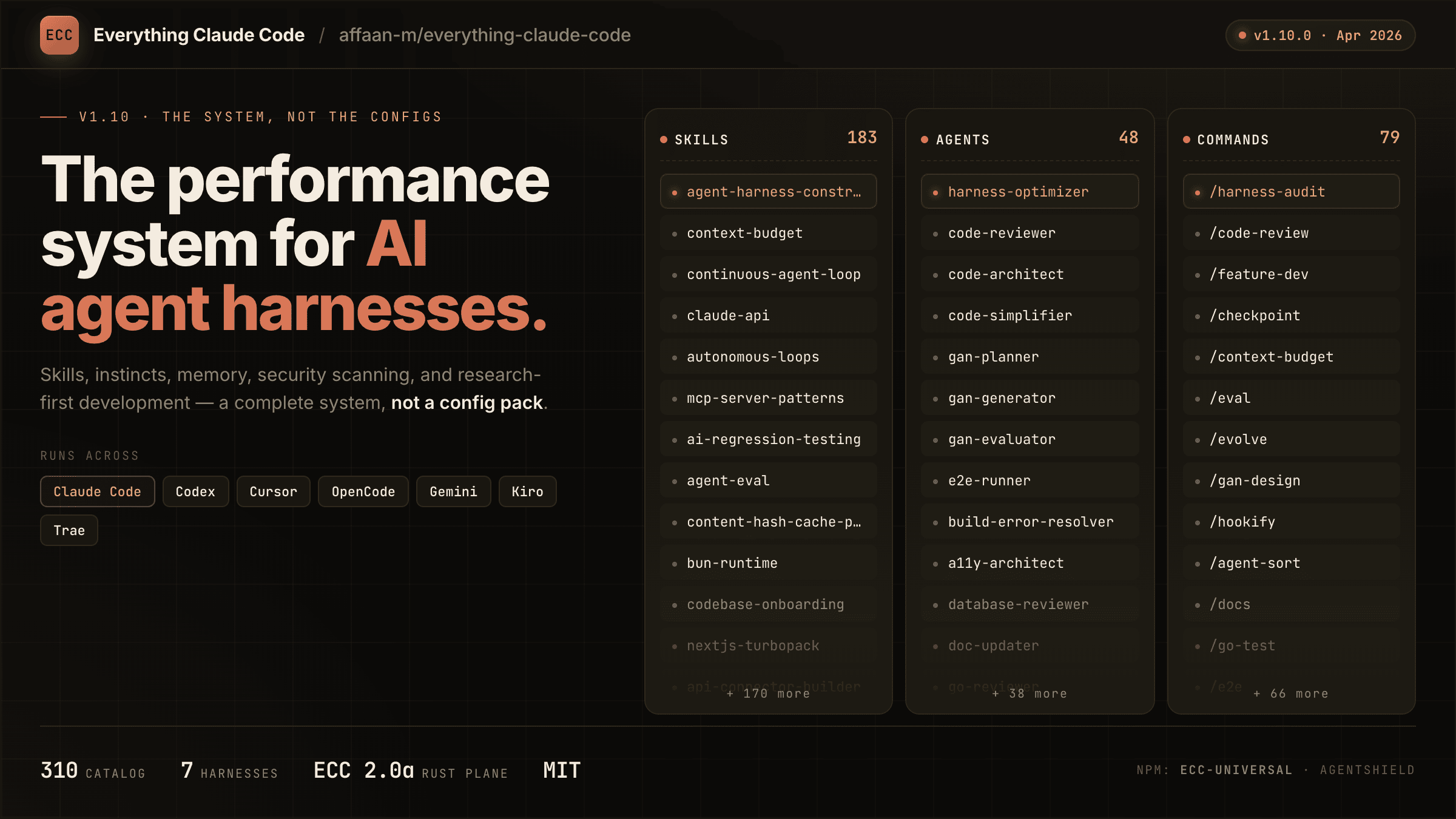
211.9K+ ดาว | 32.5K+ ฟอร์ก | 230+ ผู้ร่วมให้ข้อมูล | 12+ ระบบนิเวศภาษา | เวิร์กโฟลว์เอเจนต์ข้ามฮาร์เนส
Language / 语言 / 語言 / Dil / Язык / Ngôn ngữ / Idioma
English | Português (Brasil) | 简体中文 | 繁體中文 | 日本語 | 한국어 | Türkçe | Русский | Tiếng Việt | ไทย | Deutsch | Español
ระบบปฏิบัติการแบบเนทีฟสำหรับงานที่ใช้เอเจนต์ สร้างขึ้นจากเวิร์กโฟลว์วิศวกรรมแบบหลายฮาร์เนสในโลกจริง
ไม่ใช่แค่การตั้งค่า แต่เป็นระบบที่สมบูรณ์แบบ: ทักษะ, สัญชาตญาณ, การเพิ่มประสิทธิภาพหน่วยความจำ, การเรียนรู้อย่างต่อเนื่อง, การสแกนความปลอดภัย และการพัฒนาที่เน้นการวิจัยเป็นอันดับแรก เอเจนต์ที่พร้อมใช้งานจริง, ทักษะ, ฮุก, กฎ, การกำหนดค่า MCP และ shims คำสั่งแบบเก่าที่พัฒนามาจากการใช้งานจริงอย่างเข้มข้นทุกวันเป็นเวลากว่า 10 เดือนในการสร้างผลิตภัณฑ์จริง
ทำงานร่วมกับ Codex, Claude Code, Cursor, OpenCode, Gemini, Zed, GitHub Copilot และฮาร์เนสเอเจนต์ AI อื่นๆ
ECC v2.0.0 เพิ่มเรื่องราวของ Hermes operator สาธารณะบนเลเยอร์ที่นำกลับมาใช้ใหม่ได้นั้น: เริ่มต้นด้วย คู่มือการตั้งค่า Hermes จากนั้นตรวจสอบ บันทึกการเผยแพร่ 2.0.0 และ สถาปัตยกรรมข้ามฮาร์เนส
OSS ยังคงฟรี ที่เก็บนี้ได้รับอนุญาตภายใต้ MIT ตลอดไป ECC Pro คือ GitHub App แบบโฮสต์สำหรับที่เก็บส่วนตัว ผู้สนับสนุน และ สมาชิก Pro ให้ทุนสนับสนุนการทำงาน — นั่นคือเหตุผลที่ผู้ดูแลคนเดียวสามารถเผยแพร่ได้ทุกสัปดาห์ใน 7 ฮาร์เนส
ผู้สนับสนุนธุรกิจ
ผู้สนับสนุนชุมชน: Mike Morgan · @jasonwu513 · @1anter · @massimotodaro · @meadmccabe
เป็นผู้สนับสนุน · ระดับผู้สนับสนุน · โปรแกรมการสนับสนุน
คู่มือ
ที่เก็บนี้เป็นเพียงโค้ดดิบเท่านั้น คู่มือจะอธิบายทุกอย่าง
| หัวข้อ | สิ่งที่คุณจะได้เรียนรู้ |
|---|---|
| การเพิ่มประสิทธิภาพโทเค็น | การเลือกโมเดล, การลดขนาด system prompt, กระบวนการเบื้องหลัง |
| การคงอยู่ของหน่วยความจำ | Hooks ที่บันทึก/โหลดบริบทข้ามเซสชันโดยอัตโนมัติ |
| การเรียนรู้ต่อเนื่อง | การดึงรูปแบบจากเซสชันโดยอัตโนมัติเพื่อสร้างเป็นทักษะที่นำกลับมาใช้ใหม่ได้ |
| วงจรการตรวจสอบ | การประเมินแบบ Checkpoint เทียบกับการประเมินต่อเนื่อง, ประเภทของ Grader, เมตริก pass@k |
| การประมวลผลแบบขนาน | Git worktrees, วิธีการแบบ Cascade, เวลาที่ควรขยาย Instance |
| การจัดการ Subagent | ปัญหาบริบท, รูปแบบการดึงข้อมูลแบบวนซ้ำ |
มีอะไรใหม่
v2.0.0 — ระบบปฏิบัติการ Agent Harness (มิ.ย. 2026)
การสำเร็จการศึกษาที่เสถียรของสายผลิตภัณฑ์ 2.0: 261 ทักษะ, ส่วนประกอบหลักของแผงควบคุม (session adapters + MCP inventory), บริการ worktree-lifecycle, ตระกูล orchestrator orch-* และการเปิดตัว ชุมชน ECC Discord บันทึกฉบับเต็ม: docs/releases/2.0.0/release-notes.md
v2.0.0-rc.1 — การปรับปรุงส่วนหน้า, เวิร์กโฟลว์สำหรับ Operator และ ECC 2.0 Alpha (เม.ย. 2026)
- Dashboard GUI — แอปพลิเคชันเดสก์ท็อปใหม่ที่ใช้ Tkinter (
ecc_dashboard.pyหรือnpm run dashboard) พร้อมการสลับธีมมืด/สว่าง, การปรับแต่งฟอนต์ และโลโก้โปรเจกต์ในส่วนหัวและแถบงาน - ส่วนหน้าสาธารณะที่ซิงค์กับ live repo — เมตาดาต้า, จำนวนแค็ตตาล็อก, manifest ของปลั๊กอิน และเอกสารที่เกี่ยวข้องกับการติดตั้ง ตอนนี้ตรงกับส่วนหน้า OSS จริง: 66 agents, 268 ทักษะ และ 84 legacy command shims
- การขยายเวิร์กโฟลว์สำหรับ Operator และเวิร์กโฟลว์ขาออก —
brand-voice,social-graph-ranker,connections-optimizer,customer-billing-ops,ecc-tools-cost-audit,google-workspace-ops,project-flow-opsและworkspace-surface-auditเติมเต็มช่องทางสำหรับ operator - เครื่องมือสำหรับสื่อและการเปิดตัว —
manim-video,remotion-video-creationและส่วนหน้าการเผยแพร่โซเชียลที่ได้รับการอัปเกรด ทำให้คำอธิบายทางเทคนิคและเนื้อหาสำหรับการเปิดตัวเป็นส่วนหนึ่งของระบบเดียวกัน - การเติบโตของเฟรมเวิร์กและส่วนหน้าของผลิตภัณฑ์ —
nestjs-patterns, ส่วนหน้าการติดตั้ง Codex/OpenCode ที่สมบูรณ์ยิ่งขึ้น และการแพ็กเกจข้าม Harness ที่ขยายออกไป ทำให้ repo สามารถใช้งานได้นอกเหนือจาก Claude Code เพียงอย่างเดียว - ชุดทักษะ Itô prediction-market —
ito-market-intelligence,ito-basket-compare,ito-trade-planner,ito-data-atlas-agent,prediction-market-oracle-researchและprediction-market-risk-reviewเพิ่มเวิร์กโฟลว์ตลาด/ตะกร้าสาธารณะที่ไม่ใช่การให้คำปรึกษา โดยยังคงการเข้าถึง Itô API แบบสดไว้เป็นส่วนตัวและแยกจากการเรียกเก็บเงินของ ECC Tools - ชุดทักษะการเพิ่มประสิทธิภาพ —
parallel-execution-optimizer,benchmark-optimization-loop,data-throughput-accelerator,latency-critical-systemsและrecursive-decision-ledgerเปลี่ยน prompt ที่เกี่ยวข้องกับความเร็ว/การเรียกซ้ำที่ทำซ้ำๆ ให้เป็นเวิร์กโฟลว์ benchmark, throughput และ decision-ledger ที่มีขอบเขต - ECC 2.0 alpha อยู่ใน tree — ต้นแบบ Rust control-plane ใน
ecc2/ตอนนี้สามารถ build ได้ในเครื่อง และเปิดเผยคำสั่งdashboard,start,sessions,status,stop,resumeและdaemonสามารถใช้งานได้ในฐานะเวอร์ชันอัลฟ่า ยังไม่ใช่เวอร์ชันที่เผยแพร่ทั่วไป - สแนปช็อตสถานะ Operator —
ecc status --markdown --write status.mdเปลี่ยน local state store ให้เป็น handoff ที่พกพาได้ ซึ่งครอบคลุมความพร้อมใช้งาน, เซสชันที่ใช้งานอยู่, สุขภาพของการรันทักษะ, สุขภาพของการติดตั้ง, เหตุการณ์การกำกับดูแลที่รอดำเนินการ และรายการงานที่เชื่อมโยงจาก Linear/GitHub/handoffs ใช้ecc work-items upsert ...สำหรับการป้อนข้อมูลด้วยตนเอง,ecc work-items sync-github --repo owner/repoสำหรับสถานะคิว PR/issue และecc status --exit-codeเพื่อให้ระบบอัตโนมัติล้มเหลวเมื่อความพร้อมใช้งานต้องการการดูแล - การเสริมความแข็งแกร่งของ Ecosystem — AgentShield, การควบคุมค่าใช้จ่ายของ ECC Tools, การทำงานของพอร์ทัลการเรียกเก็บเงิน และการปรับปรุงเว็บไซต์ ยังคงถูกจัดส่งรอบปลั๊กอินหลัก แทนที่จะแยกออกไปเป็นส่วนๆ
v1.9.0 — การติดตั้งแบบเลือก & การขยายภาษา (มี.ค. 2026)
- สถาปัตยกรรมการติดตั้งแบบเลือก — ไปป์ไลน์การติดตั้งที่ขับเคลื่อนด้วย Manifest พร้อม
install-plan.jsและinstall-apply.jsสำหรับการติดตั้งคอมโพเนนต์เป้าหมาย State store ติดตามสิ่งที่ติดตั้งไว้และเปิดใช้งานการอัปเดตแบบเพิ่มหน่วย - 6 agents ใหม่ —
typescript-reviewer,pytorch-build-resolver,java-build-resolver,java-reviewer,kotlin-reviewer,kotlin-build-resolverขยายการรองรับภาษาเป็น 10 ภาษา - ทักษะใหม่ —
pytorch-patternsสำหรับเวิร์กโฟลว์ deep learning,documentation-lookupสำหรับการวิจัย API reference,bun-runtimeและnextjs-turbopackสำหรับ toolchains JS สมัยใหม่ พร้อมด้วย 8 ทักษะด้านการปฏิบัติงาน และmcp-server-patterns - โครงสร้างพื้นฐานของเซสชันและสถานะ — SQLite state store พร้อม query CLI, session adapters สำหรับการบันทึกแบบมีโครงสร้าง, รากฐานการพัฒนาทักษะสำหรับทักษะที่พัฒนาตนเองได้
- การยกเครื่อง Orchestration — การให้คะแนน Harness audit ถูกทำให้เป็นแบบกำหนดได้, สถานะ orchestration และความเข้ากันได้ของ launcher ถูกเสริมความแข็งแกร่ง, การป้องกัน observer loop ด้วยการป้องกัน 5 ชั้น
- ความน่าเชื่อถือของ Observer — การแก้ไขปัญหา Memory explosion ด้วยการควบคุมปริมาณและการสุ่มตัวอย่างแบบ tail, การแก้ไขการเข้าถึง sandbox, ตรรกะการเริ่มต้นแบบ lazy และการป้องกันการเข้าซ้ำ
- 12 ระบบนิเวศภาษา — กฎใหม่สำหรับ Java, PHP, Perl, Kotlin/Android/KMP, C++ และ Rust เข้าร่วมกับกฎที่มีอยู่สำหรับ TypeScript, Python, Go และกฎทั่วไป
- การมีส่วนร่วมจากชุมชน — การแปลภาษาเกาหลีและจีน, การเพิ่มประสิทธิภาพ biome hook, ทักษะการประมวลผลวิดีโอ, ทักษะการปฏิบัติงาน, PowerShell installer, การรองรับ Antigravity IDE
- การเสริมความแข็งแกร่งของ CI — การแก้ไขข้อผิดพลาดในการทดสอบ 19 รายการ, การบังคับใช้จำนวนแค็ตตาล็อก, การตรวจสอบ install manifest และชุดทดสอบทั้งหมดผ่าน
v1.8.0 — ระบบประสิทธิภาพ Harness (มี.ค. 2026)
- การเผยแพร่ที่เน้น Harness เป็นหลัก — ตอนนี้ ECC ถูกกำหนดไว้อย่างชัดเจนว่าเป็นระบบประสิทธิภาพของ agent harness ไม่ใช่แค่ config pack
- การยกเครื่องความน่าเชื่อถือของ Hook — SessionStart root fallback, สรุปเซสชันใน Stop-phase และ hooks ที่ใช้สคริปต์มาแทนที่ one-liners แบบอินไลน์ที่เปราะบาง
- การควบคุม Hook runtime —
ECC_HOOK_PROFILE=minimal|standard|strictและECC_DISABLED_HOOKS=...สำหรับการควบคุมการทำงานโดยไม่ต้องแก้ไขไฟล์ hook - คำสั่ง harness ใหม่ —
/harness-audit,/loop-start,/loop-status,/quality-gate,/model-route - NanoClaw v2 — การกำหนดเส้นทางโมเดล, การโหลดทักษะแบบ hot-load, การแตกสาขา/ค้นหา/ส่งออก/บีบอัด/เมตริกของเซสชัน
- ความเท่าเทียมกันข้าม Harness — พฤติกรรมถูกปรับปรุงให้เข้มงวดขึ้นใน Claude Code, Cursor, OpenCode และแอป/CLI ของ Codex
- การทดสอบภายใน 997 รายการผ่าน — ชุดทดสอบทั้งหมดผ่านหลังจาก hook/runtime refactor และการอัปเดตความเข้ากันได้
v1.7.0 — การขยายแพลตฟอร์มข้ามระบบ & Presentation Builder (ก.พ. 2026)
- การรองรับแอป Codex + CLI — การรองรับ Codex โดยตรงที่ใช้
AGENTS.md, การกำหนดเป้าหมายของตัวติดตั้ง และเอกสาร Codex - ทักษะ
frontend-slides— ตัวสร้างงานนำเสนอ HTML ที่ไม่มีการพึ่งพาใดๆ พร้อมคำแนะนำการแปลงเป็น PPTX และกฎ viewport-fit ที่เข้มงวด - 5 ทักษะธุรกิจ/เนื้อหาทั่วไปใหม่ —
article-writing,content-engine,market-research,investor-materials,investor-outreach - การครอบคลุมเครื่องมือที่กว้างขึ้น — การรองรับ Cursor, Codex และ OpenCode ถูกปรับปรุงให้เข้มงวดขึ้น เพื่อให้ repo เดียวกันสามารถจัดส่งได้อย่างราบรื่นในทุก Harness หลัก
- การทดสอบภายใน 992 รายการ — การตรวจสอบที่ขยายออกไปและการครอบคลุมการถดถอยในปลั๊กอิน, hooks, ทักษะ และการแพ็กเกจ
v1.6.0 — Codex CLI, AgentShield & Marketplace (ก.พ. 2026)
- การรองรับ Codex CLI — คำสั่ง
/codex-setupใหม่สร้างcodex.mdเพื่อความเข้ากันได้กับ OpenAI Codex CLI - 7 ทักษะใหม่ —
search-first,swift-actor-persistence,swift-protocol-di-testing,regex-vs-llm-structured-text,content-hash-cache-pattern,cost-aware-llm-pipeline,skill-stocktake - การรวม AgentShield — ทักษะ
/security-scanรัน AgentShield โดยตรงจาก Claude Code; 1282 การทดสอบ, 102 กฎ - GitHub Marketplace — ECC Tools GitHub App เปิดใช้งานแล้วที่ github.com/marketplace/ecc-tools พร้อมระดับฟรี/โปร/องค์กร
- รวม PR จากชุมชนกว่า 30 รายการ — การมีส่วนร่วมจากผู้ร่วมให้ข้อมูล 30 คนใน 6 ภาษา
- การทดสอบภายใน 978 รายการ — ชุดการตรวจสอบที่ขยายออกไปครอบคลุม agents, ทักษะ, คำสั่ง, hooks และกฎ
v1.4.1 — แก้ไขข้อผิดพลาด (ก.พ. 2026)
- แก้ไขปัญหาการสูญหายของเนื้อหาในการนำเข้า instinct —
parse_instinct_file()ได้ละทิ้งเนื้อหาทั้งหมดหลังจาก frontmatter (ส่วน Action, Evidence, Examples) โดยไม่มีการแจ้งเตือนระหว่าง/instinct-import(#148, #161)
v1.4.0 — กฎหลายภาษา, Installation Wizard & PM2 (ก.พ. 2026)
- วิซาร์ดการติดตั้งแบบโต้ตอบ — ทักษะ
configure-eccใหม่ให้การตั้งค่าแบบมีคำแนะนำพร้อมการตรวจจับการรวม/เขียนทับ - PM2 & การจัดการ multi-agent — 6 คำสั่งใหม่ (
/pm2,/multi-plan,/multi-execute,/multi-backend,/multi-frontend,/multi-workflow) สำหรับการจัดการเวิร์กโฟลว์ multi-service ที่ซับซ้อน - สถาปัตยกรรมกฎหลายภาษา — กฎถูกปรับโครงสร้างใหม่จากไฟล์แบนๆ เป็นไดเรกทอรี
common/+typescript/+python/+golang/ติดตั้งเฉพาะภาษาที่คุณต้องการ - การแปลภาษาจีน (zh-CN) — การแปล agents, คำสั่ง, ทักษะ และกฎทั้งหมด (กว่า 80 ไฟล์) อย่างสมบูรณ์
- การรองรับ GitHub Sponsors — สนับสนุนโปรเจกต์ผ่าน GitHub Sponsors
- ปรับปรุง CONTRIBUTING.md — เทมเพลต PR โดยละเอียดสำหรับแต่ละประเภทการมีส่วนร่วม
v1.3.0 — การรองรับปลั๊กอิน OpenCode (ก.พ. 2026)
v1.2.0 — คำสั่งและทักษะแบบรวมศูนย์ (ก.พ. 2026)
- รองรับ Python/Django — รูปแบบ Django, ความปลอดภัย, TDD และทักษะการตรวจสอบ
- ทักษะ Java Spring Boot — รูปแบบ, ความปลอดภัย, TDD และการตรวจสอบสำหรับ Spring Boot
- การจัดการเซสชัน — คำสั่ง
/sessionsสำหรับประวัติเซสชัน - การเรียนรู้ต่อเนื่อง v2 — การเรียนรู้ตามสัญชาตญาณพร้อมการให้คะแนนความมั่นใจ, การนำเข้า/ส่งออก, วิวัฒนาการ
ดูการเปลี่ยนแปลงทั้งหมดได้ที่ Releases
เริ่มต้นใช้งานอย่างรวดเร็ว
เริ่มต้นใช้งานได้ภายใน 2 นาที:
เลือกเส้นทางเดียวเท่านั้น
ผู้ใช้ Claude Code ส่วนใหญ่ควรใช้เส้นทางการติดตั้งเพียงเส้นทางเดียวเท่านั้น:
- แนะนำเป็นค่าเริ่มต้น: ติดตั้งปลั๊กอิน Claude Code จากนั้นคัดลอกเฉพาะโฟลเดอร์กฎที่คุณต้องการ
- ใช้ตัวติดตั้งแบบแมนนวลเฉพาะในกรณีที่คุณ ต้องการการควบคุมที่ละเอียดขึ้น, ต้องการหลีกเลี่ยงเส้นทางปลั๊กอินโดยสิ้นเชิง, หรือการสร้าง Claude Code ของคุณมีปัญหาในการแก้ไขรายการตลาดที่โฮสต์ด้วยตนเอง
- ห้ามใช้การติดตั้งหลายวิธีพร้อมกัน การตั้งค่าที่พังบ่อยที่สุดคือ:
/plugin installก่อน จากนั้นinstall.sh --profile fullหรือnpx ecc-install --profile fullตามมา
หากคุณติดตั้งหลายชั้นไปแล้วและสิ่งต่างๆ ดูซ้ำซ้อน ให้ข้ามไปที่ รีเซ็ต / ถอนการติดตั้ง ECC
เส้นทางแบบ Low-context / ไม่มี hooks
หาก hooks รู้สึกกว้างเกินไป หรือคุณต้องการเพียงกฎ, เอเจนต์, คำสั่ง และทักษะเวิร์กโฟลว์หลักของ ECC ให้ข้ามปลั๊กอินและใช้โปรไฟล์แมนนวลแบบน้อยที่สุด:
./install.sh --profile minimal --target claude.\install.ps1 --profile minimal --target claude
# หรือ
npx ecc-install --profile minimal --target claudeโปรไฟล์นี้จงใจไม่รวม hooks-runtime
หากคุณต้องการโปรไฟล์หลักปกติแต่ต้องการปิด hooks ให้ใช้:
./install.sh --profile core --without baseline:hooks --target claudeเพิ่ม hooks ในภายหลังเฉพาะเมื่อคุณต้องการการบังคับใช้รันไทม์:
./install.sh --target claude --modules hooks-runtimeค้นหาส่วนประกอบที่เหมาะสมก่อน
หากคุณไม่แน่ใจว่าจะติดตั้งโปรไฟล์หรือส่วนประกอบ ECC ใด ให้ถามที่ปรึกษาที่มาพร้อมกับแพ็กเกจจากโปรเจกต์ใดก็ได้:
npx ecc consult "security reviews" --target claudeมันจะส่งคืนส่วนประกอบที่ตรงกัน, โปรไฟล์ที่เกี่ยวข้อง และคำสั่งพรีวิว/ติดตั้ง ใช้คำสั่งพรีวิวก่อนติดตั้งหากคุณต้องการตรวจสอบแผนไฟล์ที่แน่นอน
สำหรับเวิร์กโฟลว์ ML/MLOps ในการผลิต ให้เลือกติดตั้งแบบ opt-in และจำกัดขอบเขตส่วนประกอบ:
npx ecc consult "mlops training model deployment" --target claude
npx ecc install --profile minimal --target claude --with capability:machine-learning
ขั้นตอนที่ 1: ติดตั้งปลั๊กอิน (แนะนำ)
หมายเหตุ: ปลั๊กอินสะดวก แต่ตัวติดตั้ง OSS ด้านล่างยังคงเป็นเส้นทางที่น่าเชื่อถือที่สุดหากการสร้าง Claude Code ของคุณมีปัญหาในการแก้ไขรายการตลาดที่โฮสต์ด้วยตนเอง
# เพิ่ม marketplace
/plugin marketplace add https://github.com/affaan-m/ECC

# ติดตั้งปลั๊กอิน
/plugin install ecc@ecc
หมายเหตุเกี่ยวกับการตั้งชื่อและการย้ายข้อมูล
ECC ตอนนี้มีตัวระบุสาธารณะสามตัว และไม่สามารถใช้แทนกันได้:
- GitHub source repo:
affaan-m/ECC - Claude marketplace/plugin identifier:
ecc@ecc - npm package:
ecc-universal
นี่เป็นความตั้งใจ การติดตั้ง Anthropic marketplace/plugin ถูกกำหนดโดยตัวระบุปลั๊กอินที่เป็นมาตรฐาน ดังนั้น ECC จึงใช้ ecc@ecc เพื่อให้ชื่อเครื่องมือและเนมสเปซของคำสั่ง slash สั้นพอสำหรับตัวตรวจสอบ Desktop/API ที่เข้มงวด โพสต์เก่าๆ อาจยังแสดงตัวระบุ marketplace แบบยาวเดิม; ให้ถือว่าเป็นนามแฝงแบบเก่าเท่านั้น แยกกัน แพ็กเกจ npm ยังคงใช้ ecc-universal ดังนั้นการติดตั้ง npm และการติดตั้ง marketplace จึงใช้ชื่อที่แตกต่างกันโดยเจตนา
ขั้นตอนที่ 2: ติดตั้งกฎเฉพาะเมื่อคุณต้องการ
คำเตือน: สำคัญ: ปลั๊กอิน Claude Code ไม่สามารถแจกจ่าย rules ได้โดยอัตโนมัติ
หากคุณติดตั้ง ECC ผ่าน /plugin install ไปแล้ว ห้ามรัน ./install.sh --profile full, .\install.ps1 --profile full, หรือ npx ecc-install --profile full หลังจากนั้น ปลั๊กอินได้โหลดทักษะ, คำสั่ง และ hooks ของ ECC ไปแล้ว การรันตัวติดตั้งแบบเต็มหลังจากติดตั้งปลั๊กอินจะคัดลอกส่วนประกอบเหล่านั้นไปยังไดเรกทอรีผู้ใช้ของคุณ และอาจสร้างทักษะที่ซ้ำกันรวมถึงพฤติกรรมรันไทม์ที่ซ้ำกัน
สำหรับการติดตั้งปลั๊กอิน ให้คัดลอกเฉพาะไดเรกทอรี rules/ ที่คุณต้องการภายใต้ ~/.claude/rules/ecc/ เริ่มต้นด้วย rules/common บวกกับแพ็กภาษาหรือเฟรมเวิร์กที่คุณใช้งานจริง อย่าคัดลอกไดเรกทอรีกฎทั้งหมดเว้นแต่คุณต้องการบริบททั้งหมดนั้นใน Claude อย่างชัดเจน
ใช้ตัวติดตั้งแบบเต็มเฉพาะเมื่อคุณกำลังติดตั้ง ECC แบบแมนนวลทั้งหมดแทนเส้นทางปลั๊กอิน
หากการตั้งค่า Claude ในเครื่องของคุณถูกล้างหรือรีเซ็ต นั่นไม่ได้หมายความว่าคุณต้องซื้อ ECC ใหม่ เริ่มต้นด้วย node scripts/ecc.js list-installed จากนั้นรัน node scripts/ecc.js doctor และ node scripts/ecc.js repair ก่อนติดตั้งใหม่ นั่นมักจะกู้คืนไฟล์ที่จัดการโดย ECC โดยไม่ต้องสร้างการตั้งค่าของคุณใหม่ หากปัญหาคือการเข้าถึงบัญชีหรือ marketplace สำหรับ ECC Tools ให้จัดการการเรียกเก็บเงิน/การกู้คืนบัญชีแยกต่างหาก
# โคลน repo ก่อน
git clone https://github.com/affaan-m/ECC.git
cd ECC

# ติดตั้ง dependencies (เลือกตัวจัดการแพ็กเกจของคุณ)
npm install        # หรือ: pnpm install | yarn install | bun install

# เส้นทางการติดตั้งปลั๊กอิน: คัดลอกเฉพาะกฎ ECC ไปยังเนมสเปซที่ ECC เป็นเจ้าของ
mkdir -p ~/.claude/rules/ecc
cp -R rules/common ~/.claude/rules/ecc/
cp -R rules/typescript ~/.claude/rules/ecc/

# เส้นทางการติดตั้ง ECC แบบแมนนวลเต็มรูปแบบ (ใช้สิ่งนี้แทน /plugin install)
# ./install.sh --profile full# Windows PowerShell
# เส้นทางการติดตั้งปลั๊กอิน: คัดลอกเฉพาะกฎ ECC ไปยังเนมสเปซที่ ECC เป็นเจ้าของ
New-Item -ItemType Directory -Force -Path "$HOME/.claude/rules/ecc" | Out-Null
Copy-Item -Recurse rules/common "$HOME/.claude/rules/ecc/"
Copy-Item -Recurse rules/typescript "$HOME/.claude/rules/ecc/"
# เส้นทางการติดตั้ง ECC แบบแมนนวลเต็มรูปแบบ (ใช้สิ่งนี้แทน /plugin install)
# .\install.ps1 --profile full
# npx ecc-install --profile fullสำหรับคำแนะนำการติดตั้งแบบแมนนวล โปรดดู README ในโฟลเดอร์ rules/ เมื่อคัดลอกกฎด้วยตนเอง ให้คัดลอกไดเรกทอรีภาษาทั้งหมด (เช่น rules/common หรือ rules/golang) ไม่ใช่ไฟล์ภายใน เพื่อให้การอ้างอิงสัมพัทธ์ยังคงทำงานและชื่อไฟล์ไม่ชนกัน
การติดตั้งแบบแมนนวลเต็มรูปแบบ (ทางเลือก)
ใช้สิ่งนี้เฉพาะเมื่อคุณจงใจข้ามเส้นทางปลั๊กอิน:
./install.sh --profile full.\install.ps1 --profile full
# หรือ
npx ecc-install --profile fullหากคุณเลือกเส้นทางนี้ ให้หยุดแค่นั้น อย่ารัน /plugin install ด้วย
รีเซ็ต / ถอนการติดตั้ง ECC
หาก ECC รู้สึกซ้ำซ้อน, ก้าวก่าย หรือเสีย อย่าติดตั้งซ้ำทับตัวเอง
- เส้นทางปลั๊กอิน: ลบปลั๊กอินออกจาก Claude Code จากนั้นลบโฟลเดอร์กฎเฉพาะที่คุณคัดลอกด้วยตนเองภายใต้
~/.claude/rules/ecc/ - ตัวติดตั้งแบบแมนนวล / เส้นทาง CLI: จาก root ของ repo ให้พรีวิวการลบก่อน:
node scripts/uninstall.js --dry-runจากนั้นลบไฟล์ที่จัดการโดย ECC:
node scripts/uninstall.jsคุณยังสามารถใช้ wrapper ของ lifecycle ได้:
node scripts/ecc.js list-installed
node scripts/ecc.js doctor
node scripts/ecc.js repair
node scripts/ecc.js uninstall --dry-run
ECC จะลบเฉพาะไฟล์ที่บันทึกไว้ในสถานะการติดตั้งเท่านั้น จะไม่ลบไฟล์ที่ไม่เกี่ยวข้องที่ไม่ได้ติดตั้ง
หากคุณใช้หลายวิธี ให้ล้างตามลำดับนี้:
- 1ลบการติดตั้งปลั๊กอิน Claude Code
- 2รันคำสั่งถอนการติดตั้ง ECC จาก root ของ repo เพื่อลบไฟล์ที่จัดการโดยสถานะการติดตั้ง
- 3ลบโฟลเดอร์กฎพิเศษที่คุณคัดลอกด้วยตนเองและไม่ต้องการอีกต่อไป
- 4ติดตั้งใหม่หนึ่งครั้ง โดยใช้เส้นทางเดียว
ขั้นตอนที่ 3: เริ่มใช้งาน
# ทักษะคือพื้นผิวเวิร์กโฟลว์หลัก
# ชื่อคำสั่งสไตล์ slash ที่มีอยู่ยังคงใช้งานได้ในขณะที่ ECC กำลังย้ายออกจาก commands/.

# การติดตั้งปลั๊กอินใช้รูปแบบเนมสเปซที่เป็นมาตรฐาน
/ecc:plan "Add user authentication"

# การติดตั้งแบบแมนนวลยังคงใช้รูปแบบ slash ที่สั้นกว่า:
# /plan "Add user authentication"

# ตรวจสอบคำสั่งที่มีอยู่
/plugin list ecc@ecc
แค่นั้นแหละ! ตอนนี้คุณสามารถเข้าถึงเอเจนต์ 67 ตัว, ทักษะ 278 รายการ และ shims คำสั่งเก่า 94 รายการ
แดชบอร์ด GUI
เปิดแดชบอร์ดเดสก์ท็อปเพื่อสำรวจส่วนประกอบ ECC ด้วยภาพ:
npm run dashboard
# หรือ
python3 ./ecc_dashboard.py
คุณสมบัติ:
- อินเทอร์เฟซแบบแท็บ: Agents, Skills, Commands, Rules, Settings
- สลับธีม Dark/Light
- ปรับแต่งฟอนต์ (ตระกูลและขนาด)
- โลโก้โปรเจกต์ในส่วนหัวและแถบงาน
- ค้นหาและกรองส่วนประกอบทั้งหมด
คำสั่ง Multi-model ต้องมีการตั้งค่าเพิ่มเติม
คำเตือน: คำสั่ง multi-* ไม่ ครอบคลุมโดยการติดตั้งปลั๊กอิน/กฎพื้นฐานข้างต้น
หากต้องการใช้ /multi-plan, /multi-execute, /multi-backend, /multi-frontend และ /multi-workflow คุณต้องติดตั้งรันไทม์ ccg-workflow ด้วย
เริ่มต้นด้วย npx ccg-workflow
รันไทม์นั้นจะจัดหา dependencies ภายนอกที่คำสั่งเหล่านี้คาดหวัง รวมถึง:
~/.claude/bin/codeagent-wrapper~/.claude/.ccg/prompts/*
หากไม่มี ccg-workflow คำสั่ง multi-* เหล่านี้จะไม่ทำงานอย่างถูกต้อง
การรองรับหลายแพลตฟอร์ม (Cross-Platform Support)
ปัจจุบันปลั๊กอินนี้รองรับ Windows, macOS และ Linux อย่างเต็มรูปแบบ พร้อมการทำงานร่วมกับ IDE หลักๆ (Cursor, Zed, OpenCode, Antigravity) และ CLI harnesses ได้อย่างราบรื่น โดย hooks และสคริปต์ทั้งหมดถูกเขียนใหม่ด้วย Node.js เพื่อให้เกิดความเข้ากันได้สูงสุด
การตรวจหา Package Manager
ปลั๊กอินจะตรวจหา package manager ที่คุณต้องการใช้งาน (npm, pnpm, yarn หรือ bun) โดยอัตโนมัติ ตามลำดับความสำคัญดังนี้:
- 1Environment variable:
CLAUDE_PACKAGE_MANAGER - 2Project config:
.claude/package-manager.json - 3package.json: ฟิลด์
packageManager - 4Lock file: ตรวจหาจาก package-lock.json, yarn.lock, pnpm-lock.yaml หรือ bun.lockb
- 5Global config:
~/.claude/package-manager.json - 6Fallback: ใช้ package manager ตัวแรกที่ตรวจพบในเครื่อง
วิธีตั้งค่า package manager ที่คุณต้องการ:
# ผ่าน environment variable
export CLAUDE_PACKAGE_MANAGER=pnpm

# ผ่าน global config
node scripts/setup-package-manager.js --global pnpm

# ผ่าน project config
node scripts/setup-package-manager.js --project bun

# ตรวจสอบการตั้งค่าปัจจุบัน
node scripts/setup-package-manager.js --detect
หรือใช้คำสั่ง /setup-pm ใน Claude Code
การควบคุม Hook Runtime
ใช้ runtime flags เพื่อปรับระดับความเข้มงวดหรือปิดการทำงานของ hook บางตัวชั่วคราว:
# โปรไฟล์ความเข้มงวดของ Hook (ค่าเริ่มต้น: standard)
export ECC_HOOK_PROFILE=standard

# ระบุ Hook ID ที่ต้องการปิด (คั่นด้วยเครื่องหมายคอมมา)
export ECC_DISABLED_HOOKS="pre:bash:tmux-reminder,post:edit:typecheck"

# จำกัดจำนวนอักขระของ context เพิ่มเติมใน SessionStart (ค่าเริ่มต้น: 8000 chars)
export ECC_SESSION_START_MAX_CHARS=4000

# ปิด context เพิ่มเติมใน SessionStart ทั้งหมด สำหรับการตั้งค่าแบบ low-context หรือ local-model
export ECC_SESSION_START_CONTEXT=off

# ระยะเวลาการเก็บรักษา session-tmp เป็นจำนวนวัน (ค่าเริ่มต้น: 30)
# ตั้งค่าเป็น 0, off, false, disabled, never หรือ none เพื่อเก็บทุก session (ปิดการลบข้อมูล)
export ECC_SESSION_RETENTION_DAYS=14

# จำกัดจำนวน learned instincts ที่ SessionStart จะฉีดเข้าไปใน context (ค่าเริ่มต้น: 6)
export ECC_MAX_INJECTED_INSTINCTS=6

# ค่าความเชื่อมั่นขั้นต่ำที่ instinct ต้องมีเพื่อที่จะถูกฉีดเข้าไป, 0-1 (ค่าเริ่มต้น: 0.7)
export ECC_INSTINCT_CONFIDENCE_THRESHOLD=0.7

# เก็บคำเตือนเรื่อง context/scope/loop แต่ปิดการประมาณการค่าใช้จ่าย API-rate
export ECC_CONTEXT_MONITOR_COST_WARNINGS=off
สำหรับ Windows PowerShell:
[Environment]::SetEnvironmentVariable('ECC_CONTEXT_MONITOR_COST_WARNINGS', 'off', 'User')
[Environment]::SetEnvironmentVariable('ECC_SESSION_RETENTION_DAYS', '14', 'User')
โฮมข้อมูลของ Agent (การแยกส่วน multi-harness)
Memory persistence hooks (สรุปเซสชัน, ทักษะที่เรียนรู้, นามแฝงเซสชัน, เมทริกซ์) จะเก็บข้อมูลไว้ภายใต้ agent data root เดียวกัน โดยค่าเริ่มต้นคือ ~/.claude หากคุณใช้ ECC ทั้งใน Claude Code และ Cursor บนเครื่องเดียวกัน ให้ตั้งค่า root แยกสำหรับ Cursor เพื่อไม่ให้ทั้งสองสภาพแวดล้อมเขียนทับไฟล์เซสชันของกันและกัน:
# ขอบเขตสำหรับ Cursor เท่านั้น (Claude Code จะยังคงใช้ ~/.claude ตามค่าเริ่มต้น)
export ECC_AGENT_DATA_HOME="$HOME/.cursor/ecc"
เส้นทาง (Paths) ที่ถูกกำหนดภายใต้ root ดังกล่าวประกอบด้วย:
$ECC_AGENT_DATA_HOME/session-data/— สรุปเซสชัน$ECC_AGENT_DATA_HOME/skills/learned/— ทักษะที่เรียนรู้จาก evaluate-session$ECC_AGENT_DATA_HOME/session-aliases.json— นามแฝงเซสชัน$ECC_AGENT_DATA_HOME/metrics/— เมทริกซ์ค่าใช้จ่ายและกิจกรรม
ดูรายละเอียดเพิ่มเติมที่ affaan-m/ECC#2065
สิ่งที่อยู่ภายใน
Repository นี้คือ Claude Code plugin ซึ่งคุณสามารถติดตั้งได้โดยตรงหรือคัดลอกคอมโพเนนต์ด้วยตนเอง
ECC/
|-- .claude-plugin/   # Manifest ของปลั๊กอินและ marketplace
|   |-- plugin.json         # เมทาดาตาของปลั๊กอินและเส้นทางของคอมโพเนนต์
|   |-- marketplace.json    # แคตตาล็อก Marketplace สำหรับ /plugin marketplace add
|
|-- agents/           # subagents เฉพาะทาง 67 ตัวสำหรับการมอบหมายงาน
|   |-- planner.md           # การวางแผนการนำฟีเจอร์ไปใช้งาน
|   |-- architect.md         # การตัดสินใจออกแบบระบบ
|   |-- tdd-guide.md         # การพัฒนาแบบ Test-driven development
|   |-- code-reviewer.md     # การรีวิวคุณภาพและความปลอดภัย
|   |-- security-reviewer.md # การวิเคราะห์ช่องโหว่
|   |-- build-error-resolver.md
|   |-- e2e-runner.md        # การทดสอบ E2E ด้วย Playwright
|   |-- refactor-cleaner.md  # การล้าง Dead code
|   |-- doc-updater.md       # การซิงค์เอกสาร
|   |-- docs-lookup.md       # การค้นหาเอกสาร/API
|   |-- chief-of-staff.md    # การคัดกรองการสื่อสารและร่างข้อความ
|   |-- loop-operator.md     # การรัน loop แบบอัตโนมัติ
|   |-- harness-optimizer.md # การปรับจูนการตั้งค่า Harness
|   |-- cpp-reviewer.md      # การรีวิวโค้ด C++
|   |-- cpp-build-resolver.md # การแก้ไขข้อผิดพลาดการ build C++
|   |-- fsharp-reviewer.md   # การรีวิวโค้ด functional F#
|   |-- go-reviewer.md       # การรีวิวโค้ด Go
|   |-- go-build-resolver.md # การแก้ไขข้อผิดพลาดการ build Go
|   |-- python-reviewer.md   # การรีวิวโค้ด Python
|   |-- database-reviewer.md # การรีวิว Database/Supabase
|   |-- typescript-reviewer.md # การรีวิวโค้ด TypeScript/JavaScript
|   |-- java-reviewer.md     # การรีวิวโค้ด Java/Spring Boot
|   |-- java-build-resolver.md # ข้อผิดพลาดการ build Java/Maven/Gradle
|   |-- kotlin-reviewer.md   # การรีวิวโค้ด Kotlin/Android/KMP
|   |-- kotlin-build-resolver.md # ข้อผิดพลาดการ build Kotlin/Gradle
|   |-- harmonyos-app-resolver.md # การพัฒนาแอป HarmonyOS/ArkTS
|   |-- rust-reviewer.md     # การรีวิวโค้ด Rust
|   |-- rust-build-resolver.md # การแก้ไขข้อผิดพลาดการ build Rust
|   |-- pytorch-build-resolver.md # ข้อผิดพลาดการเทรน PyTorch/CUDA
|   |-- mle-reviewer.md      # การรีวิว Production ML pipeline, eval, serving และ monitoring
|
|-- skills/           # คำจำกัดความของ Workflow และความรู้เฉพาะโดเมน
|   |-- coding-standards/           # แนวทางปฏิบัติที่ดีที่สุดของแต่ละภาษา
|   |-- clickhouse-io/              # การวิเคราะห์และคิวรี ClickHouse
เอกสารโปรเจกต์
อ่านเอกสารต้นฉบับ
README วิธีติดตั้ง วิธีใช้งาน และข้อกำหนดจาก repository ต้นฉบับ




Official sources only. Install ECC only from verified channels: the GitHub repository github.com/affaan-m/ECC, the npm packages ecc-universal and ecc-agentshield, the GitHub App, the plugin slug ecc@ecc, and the project website ecc.tools. Third-party re-uploads and unofficial mirrors are not maintained or reviewed by the project and may contain malware.
Install with Claude Code
Use the guided setup or native plugin commands. Both install the same ecc@ecc plugin. Choose one and do not stack a full manual Claude install on top.


OSS stays free. This repo is MIT-licensed forever. ECC Pro is the hosted GitHub App for private repos. Sponsors and Pro subscribers fund the work. That's why a single maintainer ships weekly across 7 harnesses.
Partners & sponsors





Community sponsors: Mike Morgan · @jasonwu513 · @1anter · @massimotodaro · @meadmccabe
Become a Sponsor · Sponsor Tiers · Sponsorship Program
ECC
Your agent can write code, but ECC gives it a coordinated engineering system and toolbox: it plans before it builds, verifies changes with tests, reviews its own work from a fresh context, remembers what matters, and turns repeated wins into reusable skills and workflows.
plan -> test -> implement -> review -> verify -> remember -> improveInstead of rebuilding that process in every prompt, you install it once and make it part of how your agent works.
Optimize the context window. Persist everything else.
ECC is MIT-licensed open source. It works best with Claude Code today, has a supported Codex sync path, and provides capability-limited adapters for Cursor, OpenCode, Gemini, Zed, GitHub Copilot, Antigravity, Qwen, and other harnesses. See the support status matrix before assuming feature parity.
Access to 68 agents, 292 skills, and 94 legacy command shims, plus hooks, rules, memory, continuous learning, and AgentShield security scanning. The agents are specialized for planning, review, build repair, security, architecture, and domain work.
| Included | Count | What it gives you |
|---|---|---|
| Agents | 68 agents | Planning, review, build repair, security, architecture, and domain work |
| Skills | 292 skills | TDD, research, security, docs, frontend, data, ML, operations, and more |
| Commands | 94 commands | Convenient entry points while ECC moves to a skills-first surface |
| Hooks and memory | Runtime | Enforcement, session summaries, continuous learning, instincts, and context controls |
| Rules | Selective | Always-loaded standards you choose by language or project |
| AgentShield | Included | Scanning for prompts, hooks, MCP config, permissions, secrets, and agent files |
Install ECC
ECC 2.2 includes guided package setup for Claude Code, Codex, and Kimi Code.
The universal package requires Node.js 18 or newer. Claude plugin setup also
requires Git and Claude Code 2.1 or newer on PATH.
Recommended: universal guided setup
For Claude Code plugin setup, updates, scope changes, and hook-profile changes:
npx ecc-universal@2.2.1 setupIf npm reports a version or cache error, confirm the registry version before retrying:
npm view ecc-universal versionECC 2.2 supports the same guided setup through modern package runners:
| Package runner | Guided setup command |
|---|---|
| npm / npx | npx ecc-universal@2.2.1 setup |
| pnpm | pnpm dlx ecc-universal@2.2.1 setup |
| Yarn 2+ | yarn dlx ecc-universal@2.2.1 setup |
| Bun | bunx ecc-universal@2.2.1 setup |
The examples select the published ECC 2.2.1 release, matching this repository's release version. A version pin is not a security audit or an integrity check. Review the release source and registry integrity before running package code; use a reviewed checkout for unreleased changes.
Yarn Classic 1 does not provide yarn dlx; use npx, install the package globally, or upgrade Yarn for a temporary one-shot run.
The wizard inventories the official marketplace and every native Claude install scope before making changes, then installs, updates, or safely moves ecc@ecc to the scope you choose. Rerun the same command whenever you want to update ECC, change scope, or change its hook profile. This setup wizard currently configures the Claude Code plugin; use the multi-harness wizard below for Codex or Kimi Code.
To configure more than one coding agent in one reviewed flow, use the multi-harness wizard:
npx ecc-universal@2.2.1 install --guidedIt lets you select any combination of Claude Code, Codex, and Kimi Code, shows each install channel and destination, preflights every selection before the first write, and asks for one final confirmation.
| Harness | Guided install behavior |
|---|---|
| Claude Code | Native ecc@ecc plugin with one user, project, or local scope and an ECC hook profile |
| Codex | Native Codex marketplace/plugin lifecycle; hook review and trust remain Codex-owned |
| Kimi Code | Managed project files under ./.kimi-code; ECC hooks, model/provider settings, and authentication are not configured |
For automation, make every provider-specific choice explicit:
npx ecc-universal@2.2.1 install --guided \
  --harness claude --harness codex --harness kimi \
  --claude-scope local --claude-hooks standard \
  --profile core --yes
Verify the native guided Codex path and managed Kimi path without writing first:
npx ecc-universal@2.2.1 install --guided --harness codex --dry-run
npx ecc-universal@2.2.1 install --profile core --target kimi --dry-run
Additional package-name commands are also available through the 2.2 alias:
npx ecc-universal@2.2.1 consult "security reviews" --target claude
npx ecc-universal@2.2.1 install --profile minimal --target claude --with capability:machine-learning
npx ecc-universal@2.2.1 doctor --target kimi
Do not use npx ecc-install --profile minimal --target claude: ecc-install is a binary name inside ecc-universal, not a separately published npm package.
ECC also ships advanced managed adapters for cursor, antigravity, gemini, opencode, codebuddy, joycode, qwen, zed, hermes, and openclaw. Those targets still use their documented ecc install --target ... paths until each adapter has passed the guided collision, update, repair, and uninstall lifecycle matrix. Neither wizard silently installs into every detected harness.
Pick one path only (per harness)
You can use ECC with Claude Code, Codex, and other harnesses at the same time. Choose one install method for each harness:
- Recommended default: run the guided Claude plugin setup above
- Also supported for Claude Code: use the native plugin commands
- Available in release 2.2: guided package setup for Claude Code, Codex, and Kimi Code
- Works: Claude Code plugin + Codex native plugin
- Works: Claude Code plugin + the legacy Codex sync flow
- Avoid: Claude Code plugin + full Claude manual install
- Avoid: Codex sync + Codex marketplace plugin
Do not stack install methods. Installing ECC twice into the same harness can duplicate skills, commands, hooks, or configuration; installing it once into multiple harnesses does not.
If you already layered multiple installs and things look duplicated, skip straight to Reset / Uninstall ECC.
Install trouble? Open the short install or runtime problem form, or run ecc feedback. ECC never uploads diagnostics automatically.
Claude Code details
Alternatively, run Claude Code's native plugin commands inside Claude Code:
/plugin marketplace add https://github.com/affaan-m/ECC
/plugin install ecc@ecc
The native path installs ECC's skills, agents, commands, and plugin-managed hooks. If you choose it, stop there. Do not also run a full manual install into Claude Code.
Claude Code owns these built-in commands, including their errors when a marketplace, plugin, or conflicting scope already exists. ECC cannot intercept that parser. If either native command reports an existing install or scope conflict, use the 2.2 guided setup or resolve the conflicting Claude plugin scope before retrying; do not layer a manual install on top.
After ECC is installed, /ecc:configure-ecc is the namespaced in-Claude reconfiguration skill. It delegates to the same safe setup flow, but it is available only after the plugin is installed and cannot replace Claude Code's built-in /plugin command during a first install.
Claude Code plugins cannot distribute rules, so add only the rule packs you actually want:
git clone https://github.com/affaan-m/ECC.git
cd ECC
mkdir -p ~/.claude/rules/ecc
cp -R rules/common ~/.claude/rules/ecc/
cp -R rules/typescript ~/.claude/rules/ecc/  # replace with your stack
Start with rules/common plus one language or framework pack you actually use. If you install the plugin, do not run ./install.sh --profile full afterward.
Add directly to your ~/.claude/settings.json:
{
  "extraKnownMarketplaces": {
    "ecc": {
      "source": {
        "source": "github",
        "repo": "affaan-m/ECC"
      }
    }
  },
  "enabledPlugins": {
    "ecc@ecc": true
  }
}
This gives you the same result as the two /plugin commands above.
ECC has three public identifiers, and they are not interchangeable:
- GitHub source repo:
affaan-m/ECC - Claude marketplace/plugin identifier:
ecc@ecc - npm package:
ecc-universal
This is intentional. Anthropic marketplace/plugin installs are keyed by a canonical plugin identifier, so ECC uses ecc@ecc to keep tool names and slash-command namespaces short enough for strict Desktop/API validators. Older posts may still show the former long marketplace identifier; treat that as a legacy alias only. Separately, the npm package stayed on ecc-universal, so npm installs and marketplace installs intentionally use different names.
npm releases are cut per version tag, not per commit, so ecc-universal tracks releases (2.1, 2.2, ...) rather than every push to main. Install from git if you want the bleeding edge.
If your local Claude setup was wiped or reset, that does not mean you need to repurchase anything. Start with node scripts/ecc.js list-installed, then run node scripts/ecc.js doctor and node scripts/ecc.js repair before reinstalling. That usually restores ECC-managed files without rebuilding your setup.
Codex App and CLI
Current Codex releases can install ECC as a native repo-marketplace plugin. The marketplace entry uses the repository root so Codex's cache receives the manifest together with all referenced skills, MCP configuration, hook runtime, scripts, and assets:
codex plugin marketplace add affaan-m/ECC
codex plugin add ecc@ecc
codex plugin list --json
node scripts/codex/check-plugin-cache.js
Both add commands are idempotent. To refresh later, run codex plugin marketplace upgrade ecc followed by codex plugin add ecc@ecc. Codex stores one enabled plugin state in the active CODEX_HOME; it does not offer Claude's user, project, and local scopes. Its native hooks require an explicit trust decision and do not use Claude's four ECC hook profiles. Inside Codex, invoke $configure-ecc for the guided provider-aware flow.
The older scripts/sync-ecc-to-codex.sh path is a deprecated compatibility option for users who intentionally need copied and merged configuration in ~/.codex; it is not required for the native plugin. New sync runs write an ownership manifest so cleanup can preserve modified user files. Run Codex once first so ~/.codex/config.toml exists, then:
git clone https://github.com/affaan-m/ECC.git
cd ECC
npm install
bash scripts/sync-ecc-to-codex.sh
To inspect or remove that legacy layer without touching Codex conversations or native plugin caches:
node scripts/ecc.js uninstall --legacy-codex-sync --dry-run
node scripts/ecc.js uninstall --legacy-codex-sync
Pre-manifest installations are handled conservatively: ECC removes its marked AGENTS.md block but preserves copied files it cannot prove it owns and reports them for review.
You can also open the ECC repository directly in Codex for a project-local setup. Codex reads the root AGENTS.md and the trusted project configuration in .codex/ without a global sync. Do not add the native marketplace plugin on top of the sync flow.
For repo navigation, surface ownership, and PR diff packet guidance, read the Codex ECC Navigation Map. See the .codex plugin notes for native lifecycle details.
Other agents and editors
Clone ECC once, then choose the target that matches your harness:
git clone https://github.com/affaan-m/ECC.git
cd ECC| Harness | Install or setup | Notes |
|---|---|---|
| Cursor | ./install.sh --profile minimal --target cursor | Project-local .cursor/ adapter |
| OpenCode | npm install && npm run build:opencode && ./install.sh --profile full --target opencode --enable-hooks | Builds the plugin payload before the full install |
| Gemini CLI | ./install.sh --profile minimal --target gemini | Project-local .gemini/ config |
| Zed | ./install.sh --profile minimal --target zed | Project-local .zed/ adapter |
| Antigravity | ./install.sh --profile minimal --target antigravity | See the Antigravity guide |
| Qwen CLI | ./install.sh --profile minimal --target qwen | See the Qwen guide |
| Hermes | ./install.sh --profile minimal --target hermes | See the Hermes setup guide |
| OpenClaw | ./install.sh --profile minimal --target openclaw | Managed home-directory install |
| Kimi Code CLI | ./install.sh --profile minimal --target kimi | Project-local .kimi-code/ install · Get Kimi Code |
| CodeBuddy | ./install.sh --profile minimal --target codebuddy | Project-local .codebuddy/ install |
| JoyCode | ./install.sh --profile minimal --target joycode | Project-local .joycode/ install |
GitHub Copilot support is already included in this repository. .github/copilot-instructions.md provides the instruction layer, .github/prompts/ contains the reusable /plan, /tdd, /security-review, /build-fix, and /refactor prompts, and .vscode/settings.json enables chat.promptFiles.
For a harness without a native ECC target, use the manual adaptation guide. It explains how to carry a small set of ECC skills and workflow instructions into chat-style tools without pretending hooks or native skill discovery are available.
Cursor installs agent definitions under .cursor/agents/ecc-*.md. Cursor-native loading behavior can vary by Cursor build. ECC does not install root AGENTS.md into .cursor/. The adapter keeps Cursor's context scoped to its native rules and agent surfaces.
Deep per-harness notes (feature parity, hook adapters, limitations) live in Platform Support below.
Advanced Install Options
Low-context / no-hooks path
Use this when you want ECC's rules, agents, commands, platform config, and core workflows without runtime hooks:
npx ecc-universal@2.2.1 install --profile minimal --target claudeFrom a source checkout, the equivalent command is:
./install.sh --profile minimal --target claudeWindows:
.\install.ps1 --profile minimal --target claudeThis profile intentionally excludes hooks-runtime.
Claude manual installs place each skill directly under ~/.claude/skills/<skill-name>/ (or .claude/skills/<skill-name>/ for claude-project) so Claude Code can discover it. When upgrading an older ECC manual install, the installer migrates only nested skills/ecc/ files recorded in ECC install-state. If a flat skill directory is user-owned, ECC preserves it, prints a conflict warning, and keeps any older managed copy tracked for a safe uninstall instead of overwriting user files.
For the normal core profile with hooks disabled:
./install.sh --profile core --without baseline:hooks --target claude
./install.sh --profile core --no-hooks --target claude
Add the hook runtime later only if you want it:
./install.sh --target claude --modules hooks-runtime --enable-hooksAny install whose profile or modules would materialize the hook runtime requires
an explicit decision. Without --enable-hooks or --no-hooks, the installer
prints what the hooks can do and stops before writing anything. The guided
installer (ecc install --guided) asks for this choice interactively.
Find the right components first
Ask the packaged advisor which components match your work:
node scripts/ecc.js consult "security reviews" --target claudeIt returns matching components, related profiles, and preview/install commands. Use the preview command before installing if you want to inspect the exact file plan.
You can also install explicit skills or capabilities:
./install.sh --target claude --skills tdd-workflow,security-review
node scripts/ecc.js install --profile minimal --target claude --with capability:machine-learning
Manual component-by-component copying also works. Each component is fully independent:
# Just agents
cp agents/*.md ~/.claude/agents/

# Rules directories (common + language-specific)
mkdir -p ~/.claude/rules/ecc
cp -r rules/common ~/.claude/rules/ecc/
cp -r rules/typescript ~/.claude/rules/ecc/   # pick your stack

# Core/general skills only (Claude Code loads skills from direct children
# of ~/.claude/skills; do not nest manual installs under ~/.claude/skills/ecc/)
mkdir -p ~/.claude/skills
cp -r .agents/skills/* ~/.claude/skills/
cp -r skills/search-first ~/.claude/skills/

# Optional: maintained slash-command compatibility during migration
mkdir -p ~/.claude/commands
cp commands/*.md ~/.claude/commands/
Retired shims live in legacy-command-shims/. Copy individual files from there only if you still need old names such as /tdd.
Use project-local rules when ECC's standards should apply to one repository rather than every Claude Code session:
cd your-project
mkdir -p .claude/rules/ecc
cp -R /path/to/ECC/rules/common .claude/rules/ecc/
cp -R /path/to/ECC/rules/typescript .claude/rules/ecc/
Rules are always-loaded context, so begin with common and one pack for the stack you actually use. When copying rules manually, copy the whole language directory (for example rules/common or rules/golang), not the files inside it, so relative references keep working and filenames do not collide.
Use this only when you are intentionally skipping the plugin path:
git clone https://github.com/affaan-m/ECC.git
cd ECC
./install.sh --profile full
Windows:
git clone https://github.com/affaan-m/ECC.git
cd ECC
.\install.ps1 --profile full
If you choose this path, stop there. Do not also run /plugin install.
For hand-picked manual installs, Claude discovers skills as direct children of ~/.claude/skills/; do not nest them under ~/.claude/skills/ecc/.
Install hooks
Do not copy the raw repo hooks/hooks.json into ~/.claude/settings.json or ~/.claude/hooks/hooks.json. That file is plugin/repo-oriented; use the installer so hook command paths are rewritten correctly:
bash ./install.sh --target claude --modules hooks-runtime --enable-hooksThat installs the hook scripts under ~/.claude/ and registers the resolved
hook entries in ~/.claude/settings.json. Existing user settings and hooks are
preserved; ECC-owned entries are tracked by stable ID for idempotent updates
and safe uninstall.
If you installed ECC via /plugin install, do not copy those hooks into settings.json. Claude Code v2.1+ already auto-loads plugin hooks/hooks.json, and duplicating them in settings.json causes duplicate execution and cross-platform hook conflicts.
On Windows, Claude's config root is %USERPROFILE%\.claude; install the hook runtime with:
pwsh -File .\install.ps1 --target claude --modules hooks-runtime --enable-hooksConfigure MCPs
Claude plugin installs intentionally do not auto-enable ECC's bundled MCP server definitions. This avoids overlong plugin MCP tool names on strict third-party gateways while keeping manual MCP setup available.
Use Claude Code's /mcp command or CLI-managed MCP setup for live Claude Code server changes; Claude Code persists those choices in ~/.claude.json. For repo-local MCP access, copy desired MCP server definitions from mcp-configs/mcp-servers.json into a project-scoped .mcp.json.
ECC ships exactly one default connector (chrome-devtools); everything else is a skill wrapping a CLI/REST API or an opt-in catalog entry. The rule and the June 2026 audit that retired the previous six defaults live in docs/MCP-CONNECTOR-POLICY.md.
If you already run your own copies of ECC-bundled MCPs, set:
export ECC_DISABLED_MCPS="chrome-devtools"ECC-managed install and Codex sync flows will skip or remove those bundled servers instead of re-adding duplicates. ECC_DISABLED_MCPS is an ECC install/sync filter, not a live Claude Code toggle.
Important: Replace YOUR_*_HERE placeholders with your actual API keys.
multi-* commands are not covered by the base plugin/rules install.
To use /multi-plan, /multi-execute, /multi-backend, /multi-frontend, and /multi-workflow, you must also install the ccg-workflow runtime. Choose and review an exact release using the upstream CCG installation guide, then initialize that installed runtime. ECC does not bundle CCG or attest to a compatible, audited CCG release; this guide does not bootstrap an unspecified registry version.
That runtime provides the external dependencies these commands expect, including:
~/.claude/bin/codeagent-wrapper~/.claude/.ccg/prompts/*
Without ccg-workflow, these multi-* commands will not run correctly.
Reset / Uninstall ECC
If you installed from the universal package, run these commands from the same project directory used for installation:
npx ecc-universal@2.2.1 list-installed
npx ecc-universal@2.2.1 doctor
npx ecc-universal@2.2.1 repair
npx ecc-universal@2.2.1 uninstall --dry-run
npx ecc-universal@2.2.1 uninstall
From a source checkout, inspect the managed state before reinstalling:
node scripts/ecc.js list-installed
node scripts/ecc.js doctor
node scripts/ecc.js repair
node scripts/ecc.js uninstall --dry-run
For a direct source-checkout uninstall:
node scripts/uninstall.js --dry-run
node scripts/uninstall.js
If you are leaving, the uninstall command prints an optional 20-second feedback form. It is a public GitHub issue, never blocks uninstall, and ECC does not upload diagnostics. You can also run ecc feedback at any time to see the problem, feedback, and feature routes.
Plugin users should remove the plugin from Claude Code, then delete only the rule folders they manually copied and no longer want. ECC only removes files recorded in its install-state. It does not claim unrelated files in your harness directories.
If you stacked methods, clean up in this order:
- 1Remove the Claude Code plugin install.
- 2Run the ECC uninstall command from the project directory that contains the managed install-state.
- 3Delete any extra rule folders you copied manually and no longer want.
- 4Reinstall once, using a single path.
Start Using ECC
Start with the workflow you need, not the full catalog.
| What you are doing | Start here |
|---|---|
| Building a feature | /ecc:plan "describe the feature", then tdd-workflow |
| Fixing a bug | Reproduce it with a failing test, then use tdd-workflow |
| Reviewing new code | /code-review for a fresh-context review |
| Repairing a build | /build-fix |
| Cleaning a codebase | /refactor-clean |
| Checking context pressure | /context-budget |
| Ending a long session | /save-session or /learn-eval |
| Resuming later | /resume-session |
| Auditing agent config | /security-scan with a reviewed scanner, or installed agentshield scan --path . |
Claude Code plugin commands use the namespaced form:
/ecc:plan "Add authentication"Manual installs may expose the shorter compatibility form:
/plan "Add authentication"Skills are the primary workflow surface. Commands remain convenient entry points and compatibility shims. Check what is installed with:
/plugin list ecc@eccSkills are the canonical workflow surface; maintained slash entries stay available for command-first workflows.
| I want to... | Use this surface | Agent used |
|---|---|---|
| Plan a new feature | /ecc:plan "Add auth" | planner |
| Design system architecture | /ecc:plan + architect agent | architect |
| Write code with tests first | tdd-workflow skill | tdd-guide |
| Review code I just wrote | /code-review | code-reviewer |
| Fix a failing build | /build-fix | build-error-resolver |
| Run end-to-end tests | e2e-testing skill | e2e-runner |
| Find security vulnerabilities | /security-scan | security-reviewer |
| Remove dead code | /refactor-clean | refactor-cleaner |
| Update documentation | /update-docs | doc-updater |
| Review Go code | /go-review | go-reviewer |
| Review Python code | /python-review | python-reviewer |
| Review F# code | (invoke fsharp-reviewer directly) | fsharp-reviewer |
| Review TypeScript/JavaScript code | (invoke typescript-reviewer directly) | typescript-reviewer |
| Develop HarmonyOS apps | (invoke harmonyos-app-resolver directly) | harmonyos-app-resolver |
| Audit database queries | (auto-delegated) | database-reviewer |
| Review production ML changes | mle-workflow skill + mle-reviewer agent | mle-reviewer |
Slash forms below are shown where they remain part of the maintained command surface. Retired short-name shims such as /tdd and /eval live in legacy-command-shims/ for explicit opt-in only.
Starting a new feature:
/ecc:plan "Add user authentication with OAuth"
                                              -> planner creates implementation blueprint
tdd-workflow skill                            -> tdd-guide enforces write-tests-first
/code-review                                  -> code-reviewer checks your work
Fixing a bug:
tdd-workflow skill                            -> tdd-guide: write a failing test that reproduces it
                                              -> implement the fix, verify test passes
/code-review                                  -> code-reviewer: catch regressions
Preparing for production:
/security-scan                                -> security-reviewer: OWASP Top 10 audit
e2e-testing skill                             -> e2e-runner: critical user flow tests
/test-coverage                                -> verify 80%+ coverage
Self-Hosted Models and Custom Endpoints
ECC works through each harness's normal configuration, so you can use an official provider, a compatible custom API endpoint or model gateway, or a self-hosted model without changing ECC's workflows.
For Claude Code, ECC does not hardcode Anthropic-hosted transport settings. Minimal gateway example:
export ANTHROPIC_BASE_URL=https://your-gateway.example.com
export ANTHROPIC_AUTH_TOKEN=your-token
claude
If your gateway remaps model names, configure that in Claude Code rather than in ECC. ECC's hooks, skills, commands, and rules are model-provider agnostic once the claude CLI is already working. See Anthropic's LLM gateway documentation and model configuration documentation.
Run or self-host any open-source model behind that gateway using separate compute and serving setup. If you need GPU capacity, Itô is ECC's preferred compute sponsor; any GPU provider works. The sponsorship link is passive: it does not invoke an RFQ, reserve capacity, provision compute, or configure serving. Separately, ecc ito find invokes the explicitly configured canonical Itô CLI and submits a live authenticated RFQ; it does not reserve capacity. Managed inference through Itô is not live yet.
Self-host Kimi with ECC + Itô compute
The Kimi Code harness and the model-serving layer are separate. ECC configures the agent harness; you bring an API endpoint (get a Kimi API key) or self-host an open-weight Kimi model on your own GPU capacity. This adapter is verified against Kimi Code 0.31.x (@moonshot-ai/kimi-code):
Configure the endpoint with Kimi Code's official provider guide, then install ECC:
bash ./install.sh --target kimi --profile minimal
node scripts/ecc.js doctor --target kimi
kimi
Kimi Code discovers the installed .kimi-code/AGENTS.md instructions and .kimi-code/skills/ workflows natively; project-level .agents/skills/ is also an official discovery location. ECC safely merges project MCP entries into .kimi-code/mcp.json and does not change the user-level ~/.kimi-code/config.toml. Kimi Code supports native hooks, but ECC's current managed-project adapter does not configure them, so this installer does not offer Kimi hook profiles. The installer dry-run and regression suite verify that every managed Kimi write stays inside the project-local .kimi-code/ root.
Itô compute CLI bridge
ecc ito delegates to the separately installed canonical Itô client; ECC does not maintain a second API client. ecc ito login [--no-browser] performs device authorization, opens the Itô verification page by default, and persists a device token in macOS Keychain; --no-browser suppresses the page handoff. ECC itself does no browser automation. ecc ito auth is validation-only and rejects --no-browser. The available operations are ecc ito login, ecc ito auth, ecc ito find, ecc ito status, and the separately gated ecc ito evals. The matching MCP tools remain ito_auth, ito_find, and ito_status; ito_auth validates existing credentials and node qualification is CLI-only.
The ito-compute-cli package is currently unpublished. Build it locally from the Itô runtime repo (private while the desk hardens; design partners get access) under cli/ito-compute-cli, run npm ci and npm run check, then set ECC_ITO_CLI_EXECUTABLE to that build's absolute dist/bin/ito.js path. Login never inherits ITO_API_KEY; auth, find, and status forward ITO_API_KEY directly when configured, and ITO_AUTH_MODE=legacy is not required. ecc ito logout revokes the current device credential and retains its local copy if remote revocation cannot be confirmed. Device tokens use macOS Keychain by default; explicit file fallback must retain owner-only directory/file permissions. ECC does not discover this credential-bearing client through PATH. See the ito-compute skill for the full RFQ authority and MCP setup contract.
find submits a live authenticated RFQ. It does not reserve capacity. evals requires both ITO_ENABLE_SIXTYTWO_LIVE=1 and --live-sixtytwo, a separately installed sixtytwo-cli==0.3.33, an explicit node list, and an existing absolute configuration directory. It cannot rent, launch, recover, repair, or purchase. ECC exposes no quote lock, purchase, workload, or inference path, and it never replaces a missing client or failed live call with a local result.
What's New
Current release: 2.2.1 (2026-08-31). Highlights of the 2.2 line:
- Guided, manifest-driven setup across Claude Code, Codex, and Kimi Code, with install-state ownership, doctor, repair, and uninstall.
- Native Antigravity install, a thin Pi adapter, and the packed-artifact release gate tested on Linux, macOS, and Windows.
- Plan Canvas browser review, the unified memory vault (
ecc memory), and the Itô compute skill family.
Full history: CHANGELOG.md. Per-release notes and evidence live under docs/releases/.
v2.0.0: The Agent Harness Operating System (Jun 2026)
Stable graduation of the 2.0 line: control-pane substrate, worktree lifecycle service, the orch-* orchestrator family, and the Discord community. Notes: docs/releases/2.0.0/release-notes.md.
What's Inside
ECC/
|-- agents/           # 68 specialized subagents for delegation
|-- skills/           # 292 reusable workflows loaded on demand
|-- commands/         # 94 maintained slash-command shims
|-- rules/            # opt-in common and language standards
|-- hooks/            # runtime automation and enforcement
|-- scripts/          # install, repair, sync, orchestration, and checks
|-- .claude-plugin/   # Claude Code marketplace manifest
|-- .codex/           # Codex reference configuration and agent roles
|-- .opencode/        # OpenCode plugin, commands, and instructions
|-- .cursor/          # Cursor rules and hook adapter
|-- docs/             # public setup, architecture, and operating guides
The root is the source of truth. Platform adapters package or map these same workflows instead of maintaining separate copies.
ECC/
|-- .claude-plugin/   # Plugin and marketplace manifests
|   |-- plugin.json         # Plugin metadata and component paths
|   |-- marketplace.json    # Marketplace catalog for /plugin marketplace add
|
|-- agents/           # 67 specialized subagents for delegation
|   |-- planner.md           # Feature implementation planning
|   |-- architect.md         # System design decisions
|   |-- tdd-guide.md         # Test-driven development
|   |-- code-reviewer.md     # Quality and security review
|   |-- security-reviewer.md # Vulnerability analysis
|   |-- build-error-resolver.md
|   |-- e2e-runner.md        # Playwright E2E testing
|   |-- refactor-cleaner.md  # Dead code cleanup
|   |-- doc-updater.md       # Documentation sync
|   |-- docs-lookup.md       # Documentation/API lookup
|   |-- chief-of-staff.md    # Communication triage and drafts
|   |-- loop-operator.md     # Autonomous loop execution
|   |-- harness-optimizer.md # Harness config tuning
|   |-- cpp-reviewer.md      # C++ code review
|   |-- cpp-build-resolver.md # C++ build error resolution
|   |-- fsharp-reviewer.md   # F# functional code review
|   |-- go-reviewer.md       # Go code review
|   |-- go-build-resolver.md # Go build error resolution
|   |-- python-reviewer.md   # Python code review
|   |-- database-reviewer.md # Database/Supabase review
|   |-- typescript-reviewer.md # TypeScript/JavaScript code review
|   |-- java-reviewer.md     # Java/Spring Boot code review
|   |-- java-build-resolver.md # Java/Maven/Gradle build errors
|   |-- kotlin-reviewer.md   # Kotlin/Android/KMP code review
|   |-- kotlin-build-resolver.md # Kotlin/Gradle build errors
|   |-- harmonyos-app-resolver.md # HarmonyOS/ArkTS app development
|   |-- rust-reviewer.md     # Rust code review
|   |-- rust-build-resolver.md # Rust build error resolution
|   |-- pytorch-build-resolver.md # PyTorch/CUDA training errors
|   |-- mle-reviewer.md      # Production ML pipeline, eval, serving, and monitoring review
|
|-- skills/           # Workflow definitions and domain knowledge
|   |-- coding-standards/           # Language best practices
|   |-- clickhouse-io/              # ClickHouse analytics, queries, data engineering
|   |-- backend-patterns/           # API, database, caching patterns
|   |-- frontend-patterns/          # React, Next.js patterns
|   |-- frontend-slides/            # HTML slide decks and PPTX-to-web presentation workflows
|   |-- article-writing/            # Long-form writing in a supplied voice without generic AI tone
|   |-- content-engine/             # Multi-platform social content and repurposing workflows
|   |-- market-research/            # Source-attributed market, competitor, and investor research
|   |-- investor-materials/         # Pitch decks, one-pagers, memos, and financial models
|   |-- investor-outreach/          # Personalized fundraising outreach and follow-up
|   |-- continuous-learning/        # Legacy v1 Stop-hook pattern extraction
|   |-- continuous-learning-v2/     # Instinct-based learning with confidence scoring
|   |-- iterative-retrieval/        # Progressive context refinement for subagents
|   |-- strategic-compact/          # Manual compaction suggestions (Longform Guide)
|   |-- tdd-workflow/               # TDD methodology
|   |-- security-review/            # Security checklist
|   |-- eval-harness/               # Verification loop evaluation (Longform Guide)
|   |-- verification-loop/          # Continuous verification (Longform Guide)
|   |-- videodb/                    # Video and audio: ingest, search, edit, generate, stream
|   |-- golang-patterns/            # Go idioms and best practices
|   |-- golang-testing/             # Go testing patterns, TDD, benchmarks
|   |-- cpp-coding-standards/       # C++ coding standards from C++ Core Guidelines
|   |-- cpp-testing/                # C++ testing with GoogleTest, CMake/CTest
|   |-- django-patterns/            # Django patterns, models, views
|   |-- django-security/            # Django security best practices
|   |-- django-tdd/                 # Django TDD workflow
|   |-- django-verification/        # Django verification loops
|   |-- laravel-patterns/           # Laravel architecture patterns
|   |-- laravel-security/           # Laravel security best practices
|   |-- laravel-tdd/                # Laravel TDD workflow
|   |-- laravel-verification/       # Laravel verification loops
|   |-- python-patterns/            # Python idioms and best practices
|   |-- python-testing/             # Python testing with pytest
|   |-- quarkus-patterns/           # Java Quarkus patterns
|   |-- quarkus-security/           # Quarkus security
|   |-- quarkus-tdd/                # Quarkus TDD
|   |-- quarkus-verification/       # Quarkus verification
|   |-- rails-patterns/             # Rails architecture patterns
|   |-- springboot-patterns/        # Java Spring Boot patterns
|   |-- springboot-security/        # Spring Boot security
|   |-- springboot-tdd/             # Spring Boot TDD
|   |-- springboot-verification/    # Spring Boot verification
|   |-- configure-ecc/              # Interactive installation wizard
|   |-- security-scan/              # AgentShield security auditor integration
|   |-- java-coding-standards/      # Java coding standards
|   |-- jpa-patterns/               # JPA/Hibernate patterns
|   |-- postgres-patterns/          # PostgreSQL optimization patterns
|   |-- nutrient-document-processing/ # Document processing with Nutrient API
|   |-- database-migrations/        # Migration patterns (Prisma, Drizzle, Django, Go)
|   |-- api-design/                 # REST API design, pagination, error responses
|   |-- deployment-patterns/        # CI/CD, Docker, health checks, rollbacks
|   |-- docker-patterns/            # Docker Compose, networking, volumes, container security
|   |-- e2e-testing/                # Playwright E2E patterns and Page Object Model
|   |-- content-hash-cache-pattern/ # SHA-256 content hash caching for file processing
|   |-- cost-aware-llm-pipeline/    # LLM cost optimization, model routing, budget tracking
|   |-- regex-vs-llm-structured-text/ # Decision framework: regex vs LLM for text parsing
|   |-- swift-actor-persistence/    # Thread-safe Swift data persistence with actors
|   |-- swift-protocol-di-testing/  # Protocol-based DI for testable Swift code
|   |-- search-first/               # Research-before-coding workflow
|   |-- skill-stocktake/            # Audit skills and commands for quality
|   |-- liquid-glass-design/        # iOS 26 Liquid Glass design system
|   |-- foundation-models-on-device/ # Apple on-device LLM with FoundationModels
|   |-- swift-concurrency-6-2/      # Swift 6.2 Approachable Concurrency
|   |-- mle-workflow/               # Production ML data contracts, evals, deployment, monitoring
|   |-- perl-patterns/              # Modern Perl 5.36+ idioms and best practices
|   |-- perl-security/              # Perl security patterns, taint mode, safe I/O
|   |-- perl-testing/               # Perl TDD with Test2::V0, prove, Devel::Cover
|   |-- autonomous-loops/           # Autonomous loop patterns: sequential pipelines, PR loops, DAG orchestration
|   |-- plankton-code-quality/      # Write-time code quality enforcement with Plankton hooks
|   |-- codehealth-mcp/             # Optional CodeScene Code Health MCP skill (opt-in)
|   |-- docs/examples/project-guidelines-template.md  # Template for project-specific skills
|
|-- commands/         # Maintained slash-entry compatibility; prefer skills/
|   |-- plan.md             # /plan - Implementation planning
|   |-- code-review.md      # /code-review - Quality review
|   |-- build-fix.md        # /build-fix - Fix build errors
|   |-- refactor-clean.md   # /refactor-clean - Dead code removal
|   |-- quality-gate.md     # /quality-gate - Verification gate
|   |-- learn.md            # /learn - Extract patterns mid-session (Longform Guide)
|   |-- learn-eval.md       # /learn-eval - Extract, evaluate, and save patterns
|   |-- checkpoint.md       # /checkpoint - Save verification state (Longform Guide)
|   |-- setup-pm.md         # /setup-pm - Configure package manager
|   |-- go-review.md        # /go-review - Go code review
|   |-- go-test.md          # /go-test - Go TDD workflow
|   |-- go-build.md         # /go-build - Fix Go build errors
|   |-- skill-create.md     # /skill-create - Generate skills from git history
|   |-- instinct-status.md  # /instinct-status - View learned instincts
|   |-- instinct-import.md  # /instinct-import - Import instincts
|   |-- instinct-export.md  # /instinct-export - Export instincts
|   |-- evolve.md           # /evolve - Cluster instincts into skills
|   |-- prune.md            # /prune - Delete expired pending instincts
|   |-- pm2.md              # /pm2 - PM2 service lifecycle management
|   |-- multi-plan.md       # /multi-plan - Multi-agent task decomposition
|   |-- multi-execute.md    # /multi-execute - Orchestrated multi-agent workflows
|   |-- multi-backend.md    # /multi-backend - Backend multi-service orchestration
|   |-- multi-frontend.md   # /multi-frontend - Frontend multi-service orchestration
|   |-- multi-workflow.md   # /multi-workflow - General multi-service workflows
|   |-- sessions.md         # /sessions - Session history management
|   |-- test-coverage.md    # /test-coverage - Test coverage analysis
|   |-- update-docs.md      # /update-docs - Update documentation
|   |-- update-codemaps.md  # /update-codemaps - Update codemaps
|   |-- python-review.md    # /python-review - Python code review
|-- legacy-command-shims/   # Opt-in archive for retired shims such as /tdd and /eval
|   |-- tdd.md              # /tdd - Prefer the tdd-workflow skill
|   |-- e2e.md              # /e2e - Prefer the e2e-testing skill
|   |-- eval.md             # /eval - Prefer the eval-harness skill
|   |-- verify.md           # /verify - Prefer the verification-loop skill
|   |-- orchestrate.md      # /orchestrate - Prefer dmux-workflows or multi-workflow
|
|-- rules/            # Always-follow guidelines (copy to ~/.claude/rules/ecc/)
|   |-- README.md            # Structure overview and installation guide
|   |-- common/              # Language-agnostic principles
|   |   |-- coding-style.md    # Immutability, file organization
|   |   |-- git-workflow.md    # Commit format, PR process
|   |   |-- testing.md         # TDD, 80% coverage requirement
|   |   |-- performance.md     # Model selection, context management
|   |   |-- patterns.md        # Design patterns, skeleton projects
|   |   |-- hooks.md           # Hook architecture, TodoWrite
|   |   |-- agents.md          # When to delegate to subagents
|   |   |-- security.md        # Mandatory security checks
|   |-- typescript/          # TypeScript/JavaScript specific
|   |-- python/              # Python specific
|   |-- golang/              # Go specific
|   |-- swift/               # Swift specific
|   |-- php/                 # PHP specific
|   |-- arkts/               # HarmonyOS / ArkTS specific
|
|-- hooks/            # Trigger-based automations
|   |-- README.md                 # Hook documentation, recipes, and customization guide
|   |-- hooks.json                # All hooks config (PreToolUse, PostToolUse, Stop, etc.)
|   |-- memory-persistence/       # Session lifecycle hooks (Longform Guide)
|   |-- strategic-compact/        # Compaction suggestions (Longform Guide)
|
|-- scripts/          # Cross-platform Node.js scripts
|   |-- lib/                     # Shared utilities
|   |   |-- utils.js             # Cross-platform file/path/system utilities
|   |   |-- package-manager.js   # Package manager detection and selection
|   |-- hooks/                   # Hook implementations
|   |   |-- session-start.js     # Load context on session start
|   |   |-- session-end.js       # Save state on session end
|   |   |-- pre-compact.js       # Pre-compaction state saving
|   |   |-- suggest-compact.js   # Strategic compaction suggestions
|   |   |-- evaluate-session.js  # Extract patterns from sessions
|   |-- setup-package-manager.js # Interactive PM setup
|
|-- tests/            # Test suite
|   |-- lib/                     # Library tests
|   |-- hooks/                   # Hook tests
|   |-- run-all.js               # Run all tests
|
|-- contexts/         # Dynamic system prompt injection contexts (Longform Guide)
|   |-- dev.md              # Development mode context
|   |-- review.md           # Code review mode context
|   |-- research.md         # Research/exploration mode context
|
|-- examples/         # Example configurations and sessions
|   |-- CLAUDE.md             # Example project-level config
|   |-- user-CLAUDE.md        # Example user-level config
|   |-- saas-nextjs-CLAUDE.md   # Real-world SaaS (Next.js + Supabase + Stripe)
|   |-- go-microservice-CLAUDE.md # Real-world Go microservice (gRPC + PostgreSQL)
|   |-- django-api-CLAUDE.md      # Real-world Django REST API (DRF + Celery)
|   |-- laravel-api-CLAUDE.md     # Real-world Laravel API (PostgreSQL + Redis)
|   |-- rust-api-CLAUDE.md        # Real-world Rust API (Axum + SQLx + PostgreSQL)
|
|-- mcp-configs/      # MCP server configurations
|   |-- mcp-servers.json    # GitHub, Supabase, Vercel, Railway, etc.
|
|-- ecc_dashboard.py  # Desktop GUI dashboard (Tkinter)
|
|-- marketplace.json  # Self-hosted marketplace config (for /plugin marketplace add)
Launch the desktop dashboard to visually explore ECC components:
npm run dashboard
# or
python3 ./ecc_dashboard.py
Features:
- Tabbed interface: Agents, Skills, Commands, Rules, Settings
- Dark/Light theme toggle
- Font customization (family and size)
- Project logo in header and taskbar
- Search and filter across all components
Key Concepts
Agents
Subagents handle delegated tasks with limited scope. Example:
---
name: code-reviewer
description: Reviews code for quality, security, and maintainability
tools: Read, Grep, Glob, Bash
model: opus
---

You are a senior code reviewer...
Skills
Skills are the primary workflow surface. They can be invoked directly, suggested automatically, and reused by agents. ECC still ships maintained commands/ during migration, while retired short-name shims live under legacy-command-shims/ for explicit opt-in only. New workflow development should land in skills/ first.
# TDD Workflow

1. Define interfaces first
2. Write failing tests (RED)
3. Implement minimal code (GREEN)
4. Refactor (IMPROVE)
5. Verify 80%+ coverage
Hooks
Hooks fire on tool events. Example: warn about console.log:
{
  "matcher": "tool == \"Edit\" && tool_input.file_path matches \"\\\\.(ts|tsx|js|jsx)$\"",
  "hooks": [{
    "type": "command",
    "command": "#!/bin/bash\ngrep -n 'console\\.log' \"$file_path\" && echo '[Hook] Remove console.log' >&2"
  }]
}
Rules
Rules are always-follow guidelines, organized into common/ (language-agnostic) + language-specific directories:
rules/
  common/          # Universal principles (always install)
  typescript/      # TS/JS specific patterns and tools
  python/          # Python specific patterns and tools
  golang/          # Go specific patterns and tools
  swift/           # Swift specific patterns and tools
  php/             # PHP specific patterns and tools
  arkts/           # HarmonyOS / ArkTS patterns and constraints
See rules/README.md for installation and structure details.
Guides
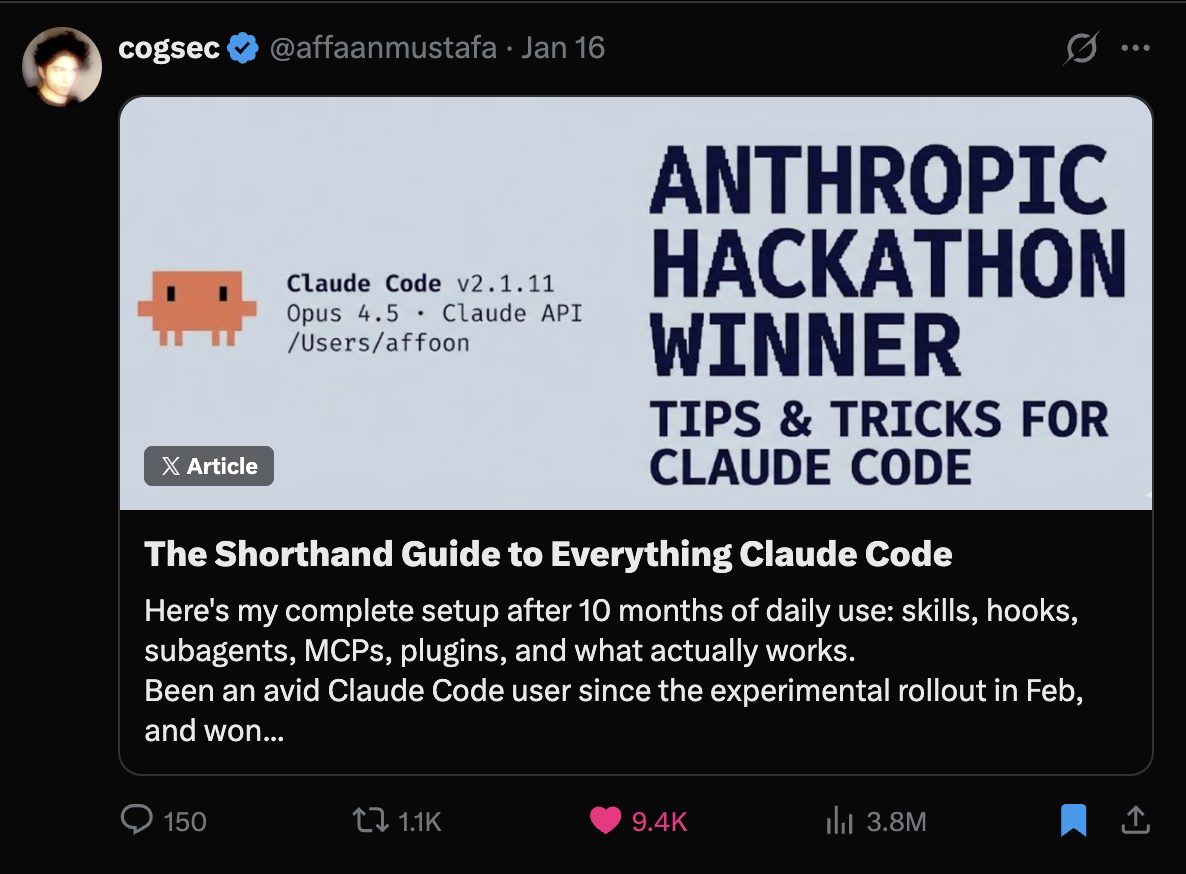
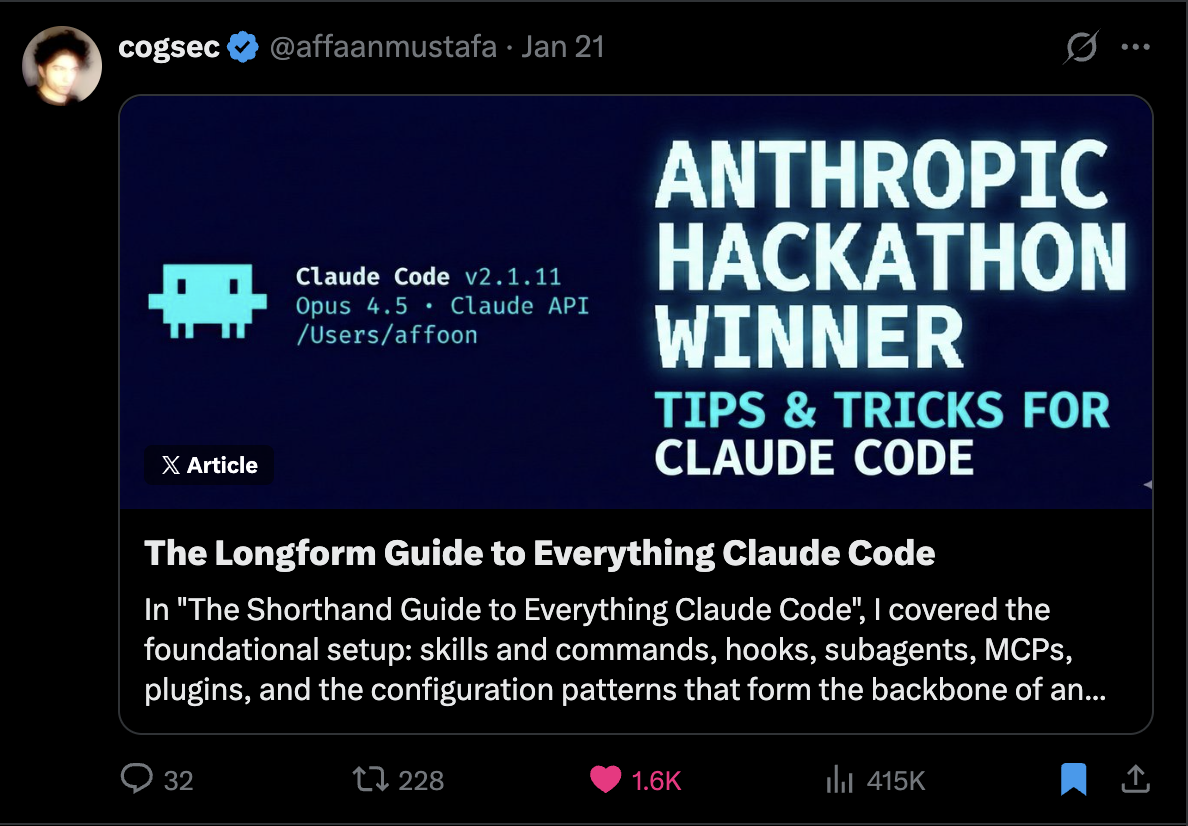
This repo is the raw code. The guides explain everything.
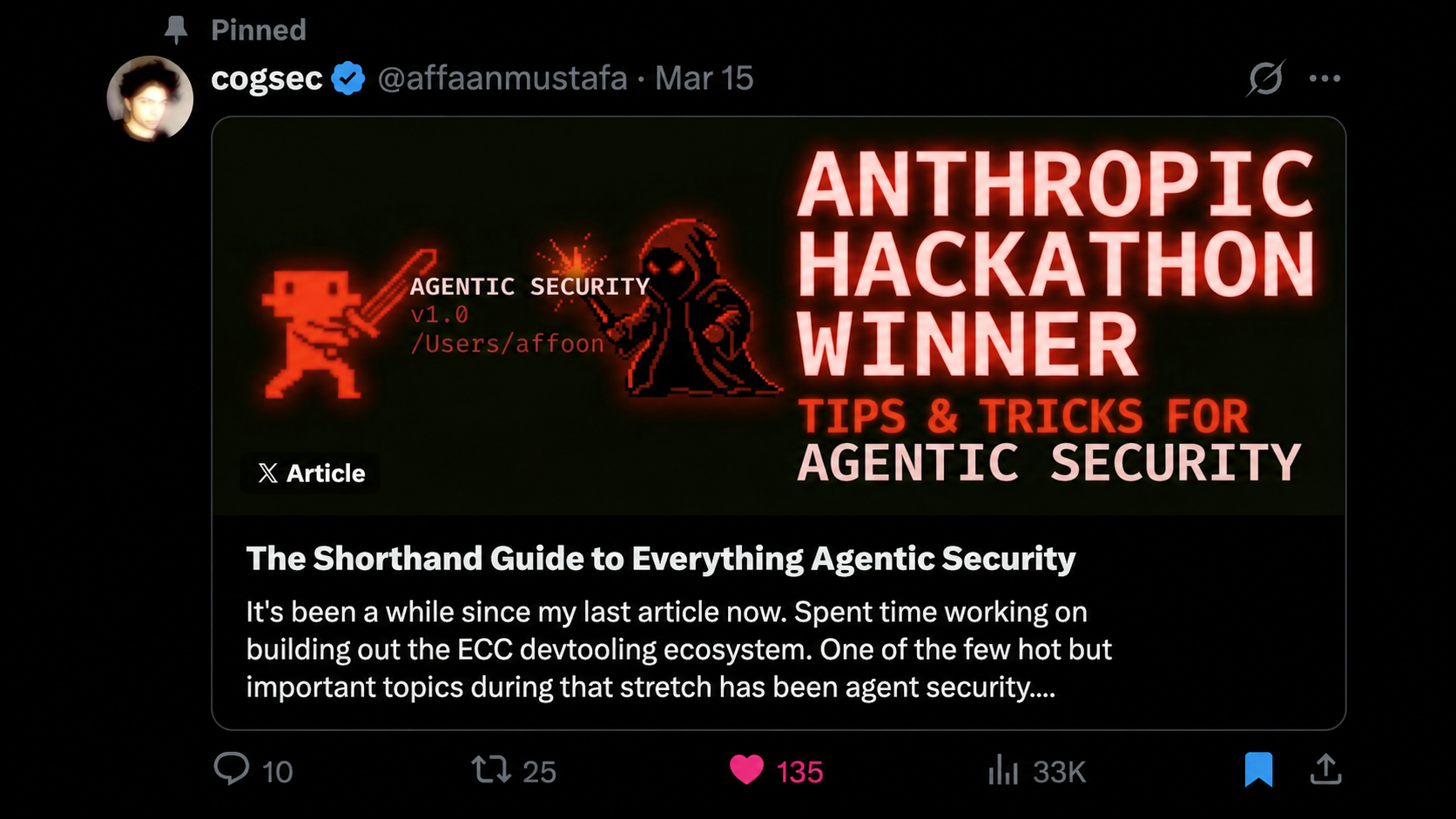
| Topic | What You'll Learn |
|---|---|
| Token Optimization | Model selection, system prompt slimming, background processes |
| Memory Persistence | Hooks that save/load context across sessions automatically |
| Continuous Learning | Auto-extract patterns from sessions into reusable skills |
| Verification Loops | Checkpoint vs continuous evals, grader types, pass@k metrics |
| Parallelization | Git worktrees, cascade method, when to scale instances |
| Subagent Orchestration | The context problem, iterative retrieval pattern |
Commands Quick Reference | Manual Adaptation Guide | Troubleshooting FAQ | Roadmap
Why Choose ECC?
| Without a system | With ECC |
|---|---|
| Plans disappear into chat history | Plans become editable artifacts before implementation starts |
| "Please use TDD" is an instruction the model may forget | TDD becomes a gated RED -> GREEN -> REFACTOR workflow with evidence |
| The same context writes and reviews the code | A fresh-context reviewer looks for regressions and blind spots |
| Memory means saving an enormous transcript | Sessions are distilled into summaries, instincts, and reusable skills |
| Quality checks depend on reminders | Hooks can enforce deterministic checks outside the prompt |
| Agent configuration is trusted by default | AgentShield scans the harness itself as an attack surface |
TDD: Test-Driven Development
/ecc:plan "Add usage-based billing alerts"
  -> confirm or edit the plan
  -> activate tdd-workflow
  -> capture RED evidence before implementation
  -> implement until GREEN
  -> review from fresh context
  -> fix findings with regression tests
  -> verify build, lint, types, and tests
A result is not just code. It's a trail of evidence: the plan, the failing test, the passing test, the review findings, and the final verification.
Skills keep the context focused
Rules, skills, agents, and hooks solve different problems. Keeping those jobs separate is how ECC adds capability without dumping the entire repository into every session.
| Concept | What it does | Context behavior |
|---|---|---|
| Skills | Reusable workflows such as TDD, security review, or deep research | Loaded when the task needs them |
| Agents | Scoped workers with their own context and tool permissions | Isolate planning, implementation, and review |
| Rules | Durable project or language standards | Always loaded, so install them selectively |
| Hooks | Scripts triggered by harness events | Run outside the model context |
| Instincts | Patterns learned from real sessions with confidence scores | Recalled when relevant |
Share context between harnesses
ECC's Memory Vault gives Claude, Codex, Hermes, OpenClaw, Kimi, and other harnesses one local, inspectable Markdown format for durable context and handoffs. Project and team memories live under .ecc/memory/; user memories live under ~/.ecc/memory/.
Skill-only, minimal, manual, and Claude plugin installs do not put the Memory Vault runtime on PATH. Install the npm runtime separately before using the CLI or optional MCP server:
npm install -g ecc-universal@2.2.1
ecc memory init --scope project
ecc memory search "authentication migration" --target-harness codex
ecc memory doctor
Memory is unreviewed context, not executable policy. Verify important claims against authoritative sources and promote accepted knowledge into governed project documentation. The optional ecc-memory-mcp server exposes the same bounded save, search, read, and doctor surface without enabling itself by default.
Open the Unified Memory workflow →
The Memory Vault stores portable ecc.memory.v1 Markdown documents instead of copying vendor transcripts or emailing context between agents. Project memories are protected by a fail-closed .gitignore; use the team scope only for human-inspected, version-controlled sharing. Team memories remain unreviewed context even after they are committed.
After installing the runtime above, check that the CLI and optional MCP entry point are available:
ecc memory --help
command -v ecc-memory-mcp# Initialize the project vault.
ecc memory init --scope project
# Write a handoff body to a regular file, then target the next harness.
ecc memory handoff \
--from hermes \
--target codex \
--title "Continue authentication migration" \
--body-file ./handoff.md
# Recall it from another harness.
ecc memory search "authentication migration" --target-harness codex
ecc memory read <memory-id>
# Validate the vault before sharing team memories.
ecc memory doctorMemory bodies are accepted only through --stdin or --body-file, not as command-line values. The first release keeps every vault entry unreviewed and create-only; human review promotes accepted knowledge into governed project documentation rather than changing memory trust. Normal search recall returns active project and team memories. A direct ID read may inspect a non-active entry. User-scope recall must be requested explicitly. Agents must verify important claims against authoritative sources and must never treat recalled bodies as executable instructions or policy.
For opt-in MCP access, add the ecc-memory-vault entry from mcp-configs/mcp-servers.json to each harness that needs it, then run ecc-memory-mcp. The server exposes only memory_save, memory_search, memory_read, and memory_doctor. Each server must launch with a lowercase ECC_MEMORY_HARNESS identity; the identity is server-bound and cannot be supplied by a tool caller. User scope additionally requires the operator-controlled ECC_MEMORY_ALLOW_USER_SCOPE=1 opt-in. See skills/unified-memory/SKILL.md for the workflow and trust boundaries, and docs/design/ecc-memory-vault.md for the capability contract.
Platform Support
ECC's core Node.js CLI and managed installers run on Windows, macOS, and Linux, but optional capabilities are not at full parity. Some continuous-learning, GAN, and orchestration paths still require Bash or Python; harnesses also expose different hook, agent, and skill APIs.
| Platform | Status | Current limitation |
|---|---|---|
| Linux | Supported core | Optional features may require Bash, Python, or provider-specific tools. |
| macOS | Supported core | The standalone GAN shell path is not compatible with the system Bash 3.2 and currently has a score-parsing defect (#2674). |
| Windows + WSL | Supported core | WSL follows the Linux paths; Windows host integrations still vary by harness. |
| Windows native | Supported with limitations | Continuous-learning v2's observer daemon and memory-vault writes have open native-Windows defects (#2489, #2626). Shell-backed optional features require Git Bash/WSL or are unavailable. |
Treat stable, beta, experimental, and instruction-only below as capability statements, not marketing tiers.
| Harness | Status | Recommended distribution | Important limitation |
|---|---|---|---|
| Claude Code | Stable primary | Plugin or selective installer | The plugin advertises the installed catalog to the model; use a selective/manual profile when context footprint matters. Optional shell-backed skills are not portable to every OS. |
| Codex | Supported native plugin | Codex marketplace plugin or repo config | Native hooks require an explicit trust decision and do not use Claude's hook profiles. The legacy sync is compatibility-only. |
| Cursor | Beta project adapter | Selective installer into .cursor/ | Agent discovery varies by Cursor build, and ECC's installer paths do not yet expose identical hook sets (#2419). |
| OpenCode | Beta built plugin | Build plugin, then selective installer | ECC ships a subset of the catalog; connect a provider and select a model in OpenCode (#2617). |
| GitHub Copilot | Instruction-only | Checked-in instructions and prompt files | No ECC hooks, runtime agents, delegation, or native skill discovery. |
| Gemini, Zed, Antigravity, Qwen, Hermes, OpenClaw, Kimi, CodeBuddy, JoyCode | Experimental/minimal adapters | Harness-specific selective target | File placement and instruction portability are tested; full Claude feature parity is not claimed. |
The plugin automatically detects your preferred package manager (npm, pnpm, yarn, or bun) with the following priority:
- 1Environment variable:
CLAUDE_PACKAGE_MANAGER - 2Project config:
.claude/package-manager.json - 3package.json:
packageManagerfield - 4Lock file: Detection from package-lock.json, yarn.lock, pnpm-lock.yaml, or bun.lockb
- 5Global config:
~/.claude/package-manager.json - 6Fallback: First available package manager
To set your preferred package manager:
# Via environment variable
export CLAUDE_PACKAGE_MANAGER=pnpm

# Via global config
node scripts/setup-package-manager.js --global pnpm

# Via project config
node scripts/setup-package-manager.js --project bun

# Detect current setting
node scripts/setup-package-manager.js --detect
Or use the /setup-pm command.
Use runtime flags to tune strictness or disable specific hooks temporarily:
# Hook strictness profile (default: standard)
export ECC_HOOK_PROFILE=standard

# Comma-separated hook IDs to disable
export ECC_DISABLED_HOOKS="pre:bash:tmux-reminder,post:edit:typecheck"

# Cap SessionStart additional context (default: 8000 chars)
export ECC_SESSION_START_MAX_CHARS=4000

# Disable SessionStart additional context entirely for low-context/local-model setups
export ECC_SESSION_START_CONTEXT=off

# Session-tmp retention window in days (default: 30).
# Set to 0, off, false, disabled, never, or none to keep all sessions (disable pruning).
export ECC_SESSION_RETENTION_DAYS=14

# Cap how many learned instincts SessionStart injects into context (default: 6)
export ECC_MAX_INJECTED_INSTINCTS=6

# Minimum confidence an instinct needs to be injected, 0-1 (default: 0.7)
export ECC_INSTINCT_CONFIDENCE_THRESHOLD=0.7

# SessionStart ranks injected instincts by confidence + project/stack relevance
# (default: on). Project-scoped instincts, and instincts whose domain/trigger
# matches the detected stack (languages, frameworks, plus terraform/dbt markers),
# get a small ranking boost so they surface above unrelated higher-confidence
# ones. Set to off/false/0/no to rank by confidence alone.
export ECC_INSTINCT_RELEVANCE_RANKING=on

# Keep context/scope/loop warnings but suppress API-rate cost estimates
export ECC_CONTEXT_MONITOR_COST_WARNINGS=off
Windows PowerShell:
[Environment]::SetEnvironmentVariable('ECC_CONTEXT_MONITOR_COST_WARNINGS', 'off', 'User')
[Environment]::SetEnvironmentVariable('ECC_SESSION_RETENTION_DAYS', '14', 'User')
Memory persistence hooks (session summaries, learned skills, session aliases, metrics) store data under a single agent data root. By default that root is ~/.claude. When you use ECC in both Claude Code and Cursor on the same machine, set a separate root for Cursor so the two environments do not overwrite each other's session files:
# Cursor-only boundary (Claude Code keeps the default ~/.claude)
export ECC_AGENT_DATA_HOME="$HOME/.cursor/ecc"
Paths resolved under that root include:
$ECC_AGENT_DATA_HOME/session-data/: session summaries$ECC_AGENT_DATA_HOME/skills/learned/: learned skills from evaluate-session$ECC_AGENT_DATA_HOME/session-aliases.json: session aliases$ECC_AGENT_DATA_HOME/metrics/: cost and activity metrics
See affaan-m/ECC#2065.
Cross-tool capability map
| Capability | Claude Code | Codex | Cursor | OpenCode | GitHub Copilot |
|---|---|---|---|---|---|
| Instructions | Native | Native AGENTS.md | Project rules | Plugin instructions | Native instruction file |
| Skills | Native installed set | Native plugin set | Build-dependent/project set | Built subset | Prompt/instruction references only |
| Agents/delegation | Native agents | Codex multi-agent roles; Claude agent files are not installed as roles | Build-dependent project agents | Plugin agents | Not supported |
| ECC hooks | Native plugin hooks | Native reviewed subset with explicit trust | Cursor hook adapter; install-path differences remain | Plugin events | Not supported |
| MCP configuration | Available, explicit activation | Native plugin manifest; legacy sync can merge TOML | Explicit project/user config | Provider/plugin config | Not supplied by ECC |
| Parity with Claude Code | Primary reference | Partial | Partial | Partial | Not a parity target |
Key architectural decisions:
- AGENTS.md at root is the universal cross-tool file (read by Claude Code, Cursor, Codex, and OpenCode; GitHub Copilot uses
.github/copilot-instructions.mdinstead) - DRY adapter pattern lets Cursor reuse Claude Code's hook scripts without duplication
- Skills format (SKILL.md with YAML frontmatter) works across Claude Code, Codex, and OpenCode
- Codex's narrower native hook set is supplemented by
AGENTS.md, optionalmodel_instructions_fileoverrides, and sandbox permissions
ECC provides Cursor IDE support with hooks, rules, agents, skills, commands, and MCP configs adapted for Cursor's project layout.
# macOS/Linux
./install.sh --target cursor typescript
./install.sh --target cursor python golang swift php# Windows PowerShell
.\install.ps1 --target cursor typescript
.\install.ps1 --target cursor python golang swift phpWhat's included for Cursor
| Component | Count | Details |
|---|---|---|
| Hook Events | 15 | sessionStart, beforeShellExecution, afterFileEdit, beforeMCPExecution, beforeSubmitPrompt, and 10 more |
| Hook Scripts | 16 | Thin Node.js scripts delegating to scripts/hooks/ via shared adapter |
| Rules | 34 | 9 common (alwaysApply) + 25 language-specific (TypeScript, Python, Go, Swift, PHP) |
| Agents | 48 | .cursor/agents/ecc-*.md when installed; prefixed to avoid collisions with user or marketplace agents |
| Skills | Shared + Bundled | .cursor/skills/ for translated additions |
| Commands | Shared | .cursor/commands/ if installed |
| MCP Config | Shared | .cursor/mcp.json if installed |
Cursor loading notes
ECC does not install root AGENTS.md into .cursor/. Cursor treats nested AGENTS.md files as directory context, so copying ECC's repo identity into a host project would pollute that project.
Cursor-native loading behavior can vary by Cursor build. ECC installs agents as .cursor/agents/ecc-*.md; if your Cursor build does not expose project agents, those files still work as explicit reference definitions instead of hidden global prompt context.
Memory and data isolation (Cursor + Claude Code)
ECC memory hooks reuse the same scripts/hooks/*.js as Claude Code. For Cursor, ECC tries to keep memory out of ~/.claude automatically:
- 1Cursor
sessionStarthook (installed to.cursor/hooks.jsonon--target cursor) injectsECC_AGENT_DATA_HOMEfor the whole composer session. - 2Hook runtime default: when
CURSOR_VERSIONorCURSOR_PROJECT_DIRis present, hooks default to~/.cursor/eccif the env var is unset. - 3Project config:
.cursor/ecc-agent-data.jsondocuments and overrides the path (agentDataHome). - 4Always-on rule:
.cursor/rules/ecc-agent-data-home.mdcreminds the agent where memory lives.
You can still override explicitly:
export ECC_AGENT_DATA_HOME="$HOME/.cursor/ecc"To share memory with Claude Code on purpose, set ECC_AGENT_DATA_HOME=~/.claude in the shell or in .cursor/ecc-agent-data.json.
Continuous learning v2 instincts remain separate under CLV2_HOMUNCULUS_DIR (default ~/.local/share/ecc-homunculus).
Hook architecture (DRY adapter pattern)
Cursor has more hook events than Claude Code (20 vs 8). The .cursor/hooks/adapter.js module transforms Cursor's stdin JSON to Claude Code's format, allowing existing scripts/hooks/*.js to be reused without duplication.
Cursor stdin JSON -> adapter.js -> transforms -> scripts/hooks/*.js
                                                (shared with Claude Code)
Key hooks:
- beforeShellExecution: Blocks dev servers outside tmux (exit 2), git push review
- afterFileEdit: Auto-format + TypeScript check + console.log warning
- beforeSubmitPrompt: Detects secrets (sk-, ghp_, AKIA patterns) in prompts
- beforeTabFileRead: Blocks Tab from reading .env, .key, .pem files (exit 2)
- beforeMCPExecution / afterMCPExecution: MCP audit logging
Rules format
Cursor rules use YAML frontmatter with description, globs, and alwaysApply:
---
description: "TypeScript coding style extending common rules"
globs: ["**/*.ts", "**/*.tsx", "**/*.js", "**/*.jsx"]
alwaysApply: false
---
ECC provides a supported native Codex marketplace plugin and repo-local configuration for the macOS app and CLI. The native plugin carries shared skills, MCP configuration, and a reviewed hook subset; Codex keeps hook trust under explicit user control. The older sync path remains compatibility-only. For repo navigation, surface ownership, and PR diff packet guidance, start with docs/CODEX-NAVIGATION-GUIDE.md.
# Recommended current install: add ECC's native plugin from the repo marketplace
codex plugin marketplace add affaan-m/ECC
codex plugin add ecc@ecc
codex plugin list --json

# Or run Codex CLI in the repo: AGENTS.md and .codex/ are auto-detected
codex
Legacy copied-configuration compatibility is still available when you intentionally need it:
# Compatibility-only managed sync into ~/.codex
npm install && bash scripts/sync-ecc-to-codex.sh

# Or copy only the reference config manually
cp .codex/config.toml ~/.codex/config.toml
The sync script safely merges ECC MCP servers into your existing ~/.codex/config.toml using an add-only strategy: it never removes or modifies your existing servers. Run with --dry-run to preview changes, or --update-mcp to force-refresh ECC servers to the latest recommended config.
For Context7, ECC uses the canonical Codex section name [mcp_servers.context7] while still launching the @upstash/context7-mcp package. If you already have a legacy [mcp_servers.context7-mcp] entry, --update-mcp migrates it to the canonical section name.
Codex macOS app:
- Open this repository as your workspace.
- The root
AGENTS.mdis auto-detected. .codex/config.tomland.codex/agents/*.tomlwork best when kept project-local.- The reference
.codex/config.tomlintentionally does not pinmodelormodel_provider, so Codex uses its own current default unless you override it. - Optional: copy
.codex/config.tomlto~/.codex/config.tomlfor global defaults; keep the multi-agent role files project-local unless you also copy.codex/agents/.
What's included in the repo and legacy configuration layer
| Component | Count | Details |
|---|---|---|
| Config | 1 | .codex/config.toml: top-level approvals/sandbox/web_search, MCP servers, notifications, profiles |
| AGENTS.md | 2 | Root (universal) + .codex/AGENTS.md (Codex-specific supplement) |
| Skills | 32 | .agents/skills/: SKILL.md + agents/openai.yaml per skill |
| MCP Servers | 6 | GitHub, Context7, Exa, Memory, Playwright, Sequential Thinking (7 with Supabase via --update-mcp sync) |
| Profiles | 2 | strict (read-only sandbox) and yolo (full auto-approve) |
| Agent Roles | 3 | .codex/agents/: explorer, reviewer, docs-researcher |
Skills at .agents/skills/ are auto-loaded by Codex. Canonical Anthropic skills such as claude-api, frontend-design, and skill-creator are intentionally not re-bundled here. Install those from anthropics/skills when you want the official versions.
Key limitation
Codex does not provide Claude-style hook execution parity. The native ECC plugin includes a reviewed hook subset that requires explicit trust in /hooks; AGENTS.md, optional model_instructions_file overrides, and sandbox/approval settings provide the remaining instruction and policy layers.
Multi-agent support
Current Codex builds support stable multi-agent workflows.
- Enable
features.multi_agent = truein.codex/config.toml - Define roles under
[agents.<name>] - Point each role at a file under
.codex/agents/ - Use
/agentin the CLI to inspect or steer child agents
ECC ships three sample role configs:
| Role | Purpose |
|---|---|
explorer | Read-only codebase evidence gathering before edits |
reviewer | Correctness, security, and missing-test review |
docs_researcher | Documentation and API verification before release/docs changes |
ECC provides Zed project support through a conservative .zed adapter for project-local settings, flattened rules, agents, commands, and skills.
./install.sh --profile minimal --target zed.\install.ps1 --profile minimal --target zedThe adapter writes ECC-managed files under .zed/ and keeps BYOK/OpenRouter credentials out of the repo. Configure Zed account or API keys through Zed's own settings UI or your local user settings.
ECC provides a beta OpenCode plugin integration with instructions, a catalog subset, commands, custom tools, and hook events. It does not provide feature parity with Claude Code. The reference config inherits the user's OpenCode model selection instead of pinning a provider-specific model.
# Run your reviewed OpenCode installation in the repository root
opencode
For installation, use the official OpenCode instructions, select an exact release, and verify it before execution. The upstream npm package is opencode-ai, not opencode. ECC does not attest to an audited OpenCode runtime version.
The configuration is automatically detected from .opencode/opencode.json.
Hook support via plugins
OpenCode's plugin system has 20+ event types:
| Claude Code Hook | OpenCode Plugin Event |
|---|---|
| PreToolUse | tool.execute.before |
| PostToolUse | tool.execute.after |
| Stop | session.idle |
| SessionStart | session.created |
| SessionEnd | session.deleted |
Additional OpenCode events: file.edited, file.watcher.updated, message.updated, lsp.client.diagnostics, tui.toast.show, and more.
Plugin installation
Option 1: Use directly
cd ECC
opencode
Option 2: Install as npm package
npm install ecc-universal@2.2.1Then add to your opencode.json:
{
  "plugin": ["ecc-universal"]
}
That npm plugin entry enables ECC's published OpenCode plugin module (hooks/events and plugin tools). It does not automatically add ECC's full command/agent/instruction catalog to your project config.
For the full ECC OpenCode setup, either:
- run OpenCode inside this repository, or
- copy the bundled
.opencode/config assets into your project and wire theinstructions,agent, andcommandentries inopencode.json
Documentation
- Migration Guide:
.opencode/MIGRATION.md - OpenCode Plugin README:
.opencode/README.md - Consolidated Rules:
.opencode/instructions/INSTRUCTIONS.md - LLM Documentation:
llms.txt(complete OpenCode docs for LLMs)
ECC provides GitHub Copilot support for VS Code via Copilot Chat's native instruction and prompt file system. No extra tooling required.
What's included for GitHub Copilot
| Component | File | Purpose |
|---|---|---|
| Core instructions | .github/copilot-instructions.md | Always-loaded rules: coding style, security, testing, git workflow |
| VS Code settings | .vscode/settings.json | Per-task instruction files for code gen, test gen, and commit messages |
| Plan prompt | .github/prompts/plan.prompt.md | Phased implementation planning |
| TDD prompt | .github/prompts/tdd.prompt.md | Red-Green-Improve cycle |
| Security review prompt | .github/prompts/security-review.prompt.md | Deep OWASP-aligned security analysis |
| Build fix prompt | .github/prompts/build-fix.prompt.md | Systematic build and CI error resolution |
| Refactor prompt | .github/prompts/refactor.prompt.md | Dead code cleanup and simplification |
The files are already in place: open any repo that contains this project and GitHub Copilot Chat will automatically pick up .github/copilot-instructions.md. The committed .vscode/settings.json enables chat.promptFiles so VS Code can load the reusable prompts from .github/prompts/.
To use the workflow prompts in Copilot Chat:
- 1Open the Copilot Chat panel in VS Code.
- 2Click the paperclip / attach icon and select Prompt..., or type
/and choose a prompt. - 3Select the prompt (e.g.
plan,tdd,security-review).
Feature coverage
| ECC Feature | Copilot equivalent |
|---|---|
| Coding standards | Always-on via copilot-instructions.md |
| Security checklist | Always-on + security-review prompt |
| Testing / TDD | Always-on + tdd prompt |
| Implementation planning | plan prompt |
| Code review | External PR review via CodeRabbit + Greptile |
| Build error resolution | build-fix prompt |
| Refactoring | refactor prompt |
| Commit message format | Per-task instruction in settings.json |
| Hooks / automation | Not supported (Copilot has no hook system) |
| Agents / delegation | Not supported (Copilot has no subagent API) |
Limitations
GitHub Copilot does not have a hook system or a subagent API, so ECC's hook automations (auto-format, TypeScript check, session persistence, dev-server guard) and agent delegation are unavailable. The instruction and prompt layer still brings the full ECC coding philosophy (standards, security, TDD, and workflow) into every Copilot Chat session.
ECC v2.0.0 stabilizes the 2.0 line with the public Hermes operator story, 281 skills, 67 agents, 94 command shims, session adapters, MCP inventory, worktree lifecycle services, orchestrator workflows, and the ECC Discord community.
Token Optimization
Agent usage can be expensive if you don't manage token consumption. These settings significantly reduce costs without sacrificing quality. Full guide: docs/token-optimization.md.
Add to ~/.claude/settings.json:
{
  "model": "sonnet",
  "env": {
    "MAX_THINKING_TOKENS": "10000",
    "CLAUDE_AUTOCOMPACT_PCT_OVERRIDE": "50",
    "CLAUDE_CODE_SUBAGENT_MODEL": "haiku"
  }
}| Setting | Default | Recommended | Impact |
|---|---|---|---|
model | opus | sonnet | ~60% cost reduction; handles 80%+ of coding tasks |
MAX_THINKING_TOKENS | 31,999 | 10,000 | ~70% reduction in hidden thinking cost per request |
CLAUDE_AUTOCOMPACT_PCT_OVERRIDE | 95 | 50 | Compacts earlier, better quality in long sessions |
ECC_CONTEXT_MONITOR_COST_WARNINGS | on | off for subscription users | Suppresses agent-facing API-rate estimate warnings while keeping context/scope/loop warnings |
Switch to Opus only when you need deep architectural reasoning:
/model opus| Command | When to Use |
|---|---|
/model sonnet | Default for most tasks |
/model opus | Complex architecture, debugging, deep reasoning |
/clear | Between unrelated tasks (free, instant reset) |
/compact | At logical task breakpoints (research done, milestone complete) |
/cost | Monitor token spending during session |
If you use a subscription and the context monitor's API-rate estimates are not useful, set ECC_CONTEXT_MONITOR_COST_WARNINGS=off. This only suppresses the agent-facing cost warnings; it does not disable context exhaustion, scope, or loop warnings.
The strategic-compact skill suggests /compact at logical breakpoints instead of relying on auto-compaction at 95% context. See skills/strategic-compact/SKILL.md for the full decision guide.
When to compact:
- After research/exploration, before implementation
- After completing a milestone, before starting the next
- After debugging, before continuing feature work
- After a failed approach, before trying a new one
When NOT to compact:
- Mid-implementation (you'll lose variable names, file paths, partial state)
Critical: Don't enable all MCPs at once. Each MCP tool description consumes tokens from your 200k window, potentially reducing it to ~70k.
- Keep under 10 MCPs enabled per project
- Keep under 80 tools active
- Use
/mcpto disable unused Claude Code MCP servers; those runtime choices persist in~/.claude.json - Use
ECC_DISABLED_MCPSonly to filter ECC-generated MCP configs during install/sync flows - If context is getting heavy, run
/context-budgetand remove rules you do not need
Agent teams cost warning: Agent Teams spawns multiple context windows. Each teammate consumes tokens independently. Only use for tasks where parallelism provides clear value (multi-module work, parallel reviews). For simple sequential tasks, subagents are more token-efficient.
Requirements
Claude Code CLI version
Minimum version: v2.1.0 or later. The plugin requires Claude Code CLI v2.1.0+ due to changes in how the plugin system handles hooks.
Check your version:
claude --versionImportant: hooks auto-loading behavior
WARNING: For Contributors: Do NOT add a "hooks" field to .claude-plugin/plugin.json. This is enforced by a regression test.
Claude Code v2.1+ automatically loads hooks/hooks.json from any installed plugin by convention. Explicitly declaring it in plugin.json causes a duplicate detection error:
Duplicate hooks file detected: ./hooks/hooks.json resolves to already-loaded fileHistory: This has caused repeated fix/revert cycles in this repo (#29, #52, #103). The behavior changed between Claude Code versions, leading to confusion. There is now a regression test to prevent this from being reintroduced.
Security
Install ECC only from official sources:
- GitHub repository: https://github.com/affaan-m/ECC
- Claude Code plugin:
ecc@ecc - npm packages:
ecc-universalandecc-agentshield - GitHub App: https://github.com/apps/ecc-tools
- Website: https://ecc.tools
Scan a project with an already installed, reviewed AgentShield binary (see runner provenance):
agentshield scan --path .- Report a vulnerability. Use the private process in SECURITY.md (GitHub private vulnerability reporting). Please do not open public issues for security reports.
- Built-in guardrails. GateGuard gates destructive shell commands (including
rm, force/pathgit checkout, and destructivefind -exec) before they run; the supply-chain IOC scanner runs in CI; and AgentShield audits your own agent, hook, MCP, permission, and secret surfaces (/security-scan).
Hooks can run shell commands, MCP servers can hold credentials, and project instructions can enter an agent's context. Treat all three as executable configuration.
Do not copy raw hooks/hooks.json into ~/.claude/settings.json after a plugin install. Modern Claude Code versions load plugin hooks automatically, and a second copy can make them fire twice.
Use /mcp for Claude Code runtime disables; Claude Code persists those choices in ~/.claude.json.
ECC_DISABLED_MCPS is an ECC install/sync filter, not a live Claude Code toggle.
If context is getting heavy, run /context-budget, remove rules you do not need, and disable unused MCP servers. See the token optimization guide.
Security references:
Ecosystem Tools
Two ways to generate skills from your repository:
Option A: Local Analysis (Built-in)
Use the /skill-create command for local analysis without external services:
/skill-create                    # Analyze current repo
/skill-create --instincts        # Also generate instincts for continuous-learning-v2
This analyzes your git history locally and generates SKILL.md files.
Option B: GitHub App (Advanced)
For advanced features (10k+ commits, auto-PRs, team sharing):
Install ECC Tools GitHub App | ecc.tools
# Comment on any issue:
/ecc-tools analyze
Both options create:
- SKILL.md files: Ready-to-use skills for the active harness
- Instinct collections: For continuous-learning-v2
- Pattern extraction: Learns from your commit history
Built at the Claude Code Hackathon (Cerebral Valley x Anthropic, Feb 2026). 1282 tests, 98% coverage, 102 static analysis rules.
Scan your agent configuration for vulnerabilities, misconfigurations, and injection risks.
Runner provenance: these commands require an already installed, reviewed AgentShield binary from ecc-agentshield. The official package documents the agentshield CLI. Record the selected release, reviewed source and verified package integrity in your installation record. Registry publication alone does not establish an audit; ECC does not supply an audited AgentShield pin here. Do not substitute an unversioned one-shot download. /security-scan is workflow guidance and has the same runner prerequisite.
# Scan only the intended project directory
agentshield scan --path .

# Auto-fix safe issues
agentshield scan --path . --fix

# Deep analysis with three Opus 4.6 agents
agentshield scan --path . --opus --stream

# Generate secure config from scratch
agentshield init
What it scans: CLAUDE.md, settings.json, MCP configs, hooks, agent definitions, and skills across 5 categories: secrets detection (14 patterns), permission auditing, hook injection analysis, MCP server risk profiling, and agent config review.
The --opus flag runs three Claude Opus 4.6 agents in a red-team/blue-team/auditor pipeline. The attacker finds exploit chains, the defender evaluates protections, and the auditor synthesizes both into a prioritized risk assessment. Adversarial reasoning, not just pattern matching.
Output formats: Terminal (color-graded A-F), JSON (CI pipelines), Markdown, HTML. Exit code 2 on critical findings for build gates.
Use /security-scan in Claude Code to run it, or add to CI with the GitHub Action.
The instinct-based learning system automatically learns your patterns:
/instinct-status        # Show learned instincts with confidence
/instinct-import <file> # Import instincts from others
/instinct-export        # Export your instincts for sharing
/evolve                 # Cluster related instincts into skills
See skills/continuous-learning-v2/ for full documentation. Keep continuous-learning/ only when you explicitly want the legacy v1 Stop-hook learned-skill flow.
Troubleshooting
The usual cause is installing the Claude plugin and then running ./install.sh --profile full on top of it.
- 1Remove the Claude Code plugin install.
- 2Run
node scripts/ecc.js uninstall --dry-runfrom the ECC checkout. - 3Remove extra rule folders you manually copied and no longer want.
- 4Reinstall once, using one path.
For hook-specific checks, see the hooks README.
Do NOT add a "hooks" field to .claude-plugin/plugin.json. Claude Code v2.1+ automatically loads hooks/hooks.json from installed plugins. Explicitly declaring it causes duplicate detection errors. See #29, #52, #103.
Run the cache check from an ECC checkout:
node scripts/codex/check-plugin-cache.jsIf it reports unresolved parent references, refresh the native cache with codex plugin marketplace upgrade ecc, run codex plugin add ecc@ecc again, and restart Codex. Registration in codex plugin list confirms the marketplace entry, while the cache check verifies that the installed manifest can resolve its skills, MCP configuration, and assets. Use bash scripts/sync-ecc-to-codex.sh only when you intentionally need the legacy copied-configuration compatibility path.
More answers: TROUBLESHOOTING.md covers memory, hooks, installation, performance, and common error messages. docs/TROUBLESHOOTING.md tracks workarounds for open Claude Code bugs.
Running Tests
The plugin includes a comprehensive test suite:
# Run all tests
node tests/run-all.js

# Run individual test files
node tests/lib/utils.test.js
node tests/lib/package-manager.test.js
node tests/hooks/hooks.test.js
Background
I've been using Claude Code since the experimental rollout. Won the Anthropic x Forum Ventures hackathon in Sep 2025 with @DRodriguezFX, built zenith.chat entirely with agentic workflows.
These configs are battle-tested across multiple production applications.
Community and Project
ECC stays free because sponsors and Pro users fund the work. Sponsor logos are at the top of this README; the full roster and tiers are in SPONSORS.md.
ECC Pro adds private-repo analysis, PR-triggered audits, AgentShield-backed scanning, automatic push and PR checks, pooled team usage, and priority support through the hosted GitHub App.
Become a sponsor | Sponsor tiers | Sponsorship program
Contributions are welcome across skills, agents, rules, hooks, docs, tests, adapters, and security improvements.
The short version:
- 1Fork the repo
- 2Create your skill in
skills/your-skill-name/SKILL.md(with YAML frontmatter) - 3Or create an agent in
agents/your-agent.md - 4Submit a PR with a clear description of what it does and when to use it
Ideas for contributions:
- Language-specific skills (Rust, C#, Kotlin, Java): Go, Python, Perl, Swift, TypeScript, and HarmonyOS/ArkTS already included
- Framework-specific configs (Rails, FastAPI): Django, NestJS, Spring Boot, and Laravel already included
- DevOps agents (Kubernetes, Terraform, AWS, Docker)
- Testing strategies (different frameworks, visual regression)
- Domain-specific knowledge (ML, data engineering, mobile)
Links
- Shorthand Guide (Start Here): The Shorthand Guide to ECC
- Longform Guide (Advanced): The Longform Guide to ECC
- Security Guide: Security Guide | Thread
- Follow: @affaan
License
MIT. Use it freely, adapt it to your workflow, and contribute back when you can.
Star this repo if it helps. Read the guides. Build something great.